Saturday, June 02, 2012

It isn't working

Hopi Sen has produced a hefty digest of opinion polling on the government’s spending cuts, with charts aplenty.

My quick summary:

Consistently, most people agree that spending cuts are necessary. But on the scale and speed of the cuts, more people agree that the government is going too far too fast than disagree. That said, the ‘too far too fast’ lead has been declining gently – until March this year, the month of the Budget. Then it shot up again, back to earlier levels.

Hopi asks:

If the public consensus on the cuts (needed, but done too quickly and too deeply) has been static, or even moved slightly toward the government position, with the post budget "slump" only returning the numbers to the position six months back, is there anything which explains why the government is doing so much worse than it was then?

(And the government is doing worse now: on YouGov voting intention, the Conservatives were in the mid-to-high 30s for the year up to early March, but in April and May they’ve been in the low 30s.)

Hopi suggests the answer may lie in whether people think the cuts are being done fairly or unfairly:

Here, there's no perceptible shift toward the government position over the last 18 months. What's more, after the budget, the numbers who think the cuts are being done unfairly has surged to record heights.

There’s surely some truth in that. The scrapping of the 50p income tax rate sent a lot of people the signal that the rich were being spared their fair share of the pain.

But I suggest people’s views on the effectiveness of government policy are a driving force too:


This chart (data from YouGov) shows a sharp drop in confidence in the government’s economic policies the week after the Budget (21 March), and another drop just after the official announcement of a double-dip recession (25 April).

The last Conservative government claimed ownership of the economic pain at the start of the 1990s – “a price well worth paying”, “if it isn’t hurting, it isn’t working” – and in the 1992 election, we grudgingly accepted it. But then came Black Wednesday, and we realised that they couldn’t even succeed at screwing us over for our own good. They never recovered.

Cameron and Osborne are not in Major and Lamont’s league yet, but if the view takes hold that all this austerity isn’t working, they’ll be in real trouble.

Thursday, May 24, 2012

Explaining bad things

The Jewish Chonicle reports:

Education Secretary Michael Gove has strongly criticised an exam board over a GCSE religious studies question in which pupils were asked: “Explain, briefly, why some people are prejudiced against Jews.”

I’m quite baffled at why this question was included, partly because I don’t see how it could be answered “briefly” – at least, if you want to go beyond “some people are nasty”. You could describe the characteristic attitudes of antisemitism straightforwardly enough, but to explain the causation – political, cultural, psychological, historical, religious – would be a lot more involved.

And of course there’s the moral objection:

Mr Gove declared: “To suggest that antisemitism can ever be explained, rather than condemned, is insensitive and, frankly, bizarre. AQA needs to explain how and why this question was included in an exam paper.”

“Insensitive” and “bizarre” are right: the question was bound to be received badly. But Gove’s second sentence there demonstrates that asking somebody to “explain” something doesn’t imply that you think it might be excusable.

Thursday, May 17, 2012

The failing economy is the real cause of cheap government borrowing

David Cameron today said:
Deficit reduction and growth are not alternatives. Delivering the first is vital in securing the second. If markets don’t believe you are serious about dealing with your debts, your interest rates rocket and your economy shrinks. … Those who argue we should spend more want us to borrow more, driving up our deficit and our debt and putting our hard-won credibility and low interest rates at risk.
There’s a logic to it: if government borrowing goes up, then the markets will get worried about lending to it and charge a higher interest rate. That may not become a Greek-style debt spiral, but even so, more expensive borrowing costs the taxpayer more and makes cuts to public services more likely.

But are things working the way Cameron suggests?

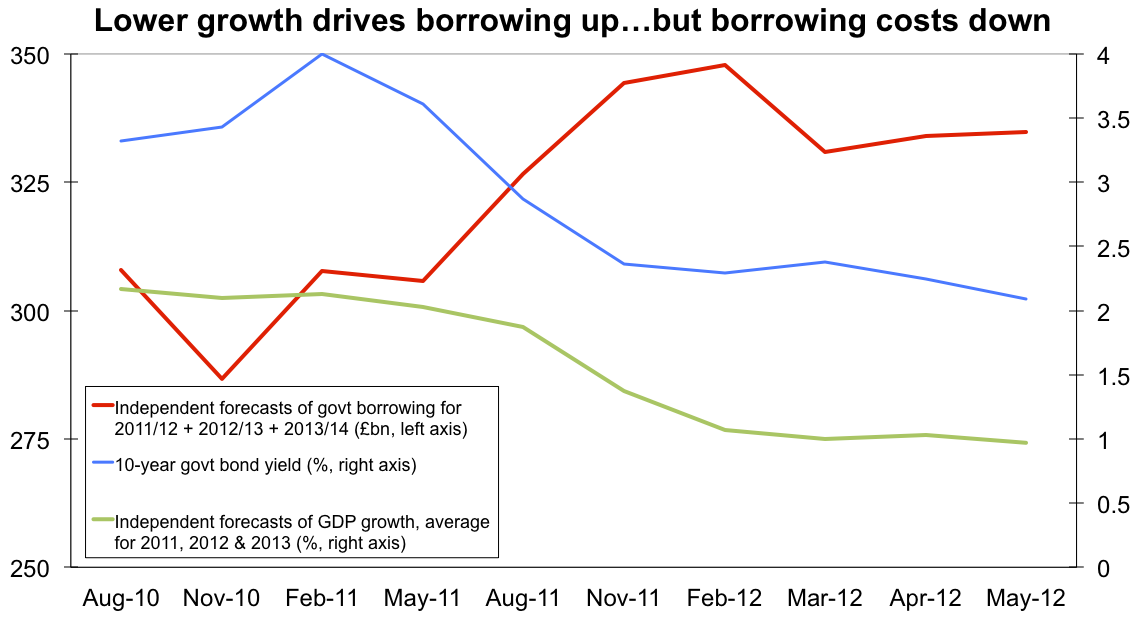
Not exactly. The amount of money that the government is expected to borrow over the next few years has gone up, not down. This rise in expected borrowing undermines Cameron’s claim that he is sticking fast to a plan that is working out well. The one thing he’s right about is that government borrowing costs have been falling. Oddly, these two changes have gone hand in hand.

This chart shows the yield on ten-year government bonds – a standard benchmark for the cost of borrowing – along with the changing independent economic forecasts of government borrowing over 2011/12 to 2013/14:


If the intuitive logic were right, you’d expect the two lines to rise and fall in tandem. But exactly the opposite happens (a strong negative correlation of –0.85). As the government’s plans for reducing borrowing get knocked farther off track, the markets become happier to lend to it more and more cheaply.

 Why?

The answer is that the prospects for the economy have been getting worse. Here’s the same graph with the independent forecasts of GDP growth for 2011 to 2013 added in:


As you’d expect, when growth prospects go down, predicted government borrowing goes up (a correlation of –0.83).

But the worsening economy also means cheaper government borrowing (correlation +0.93). The reason for that is that as the private sector struggles to generate growth, investors become reluctant to buy corporate bonds. So they turn to government bonds, and the increased demand for these means that the government can get away with offering a lower interest rate.

International factors such as Greece are also relevant: investors flee crisis-hit countries’ government bonds and go for the relative safety of UK, US, German and Japanese bonds. But this was happening even before the 2010 election: under Brown and Cameron alike, the markets haven’t thought there was any real risk of the UK losing control of its debts and defaulting. For more on that, see my post from last November.

Cheap government borrowing may be good for the Treasury, but in the current circumstances it’s not a sign of ever-increasing confidence in the government’s plans (which are really not working out as well as hoped). It’s a sign that the private sector is so weak that nobody wants to invest in it.

Tuesday, April 17, 2012

Noir Labour

It was spring, but nobody’d gotten round to telling the city. I stepped outside and the morning hit me, cold, gray and lifeless like a regional policy forum.

My back was crying bloody murder from the chair I’d been in all night, staking out one of those crazy fringe groups. They weren’t mob but the mob liked to use them for jobs now and again. Nice and deniable.

Think-tanks, they called themselves. Well I knew what I thought of that. I’d just spent ten hours staring through a dirty window at squat. You could watch those goggle-eyed freaks for ever and not see them do a damn thing.

My car was a few blocks off. I was on my way when I ran into Yvette, hauling some lowlife off to the cells. Yvette was Eddy Boy’s woman – leastways that’s how he liked to tell it. We all knew who ran that little show. She was a piece of work. Legs that went on longer than a select committee meeting and a stare that could cut through bullshit like butter.

“Looking good, Yvette. What’s new?”

“Everything but your lazy banter.”

Yvette didn’t kid around. A damn good cop but no sense of humor. But I wasn’t in her league and we both knew it, so no harm, right?

I nodded at the weasel in the cuffs. “What’s this one been up to?”

“Tried to smash up the public library.”

“So, you booked him, huh?”

She pretended not to hear. Kindest thing anyone did to me that day.

I started back on my way, but she called out: “Hey, there’s one thing. The new chief wants to see you. Better get your ass down to headquarters.”

And that’s when it all started to go wrong.

* * *

After a slug of bourbon from the flask under my dash, I’d been driving a few minutes when I saw him. Clegg, kicking his no-good heels by an alleyway, eyes full of nothing. Waiting for who the hell knew what.

For a while, Clegg had looked like he might make something of himself. But now here he was, errand-boy for the mob. He’d go off and do their dirty work, every time their laughter ringing in his ears, and every time he’d come back for more. He’d found himself a rut and called it home.

The new chief once told me about some Swedish quack who says when you’ve been held hostage long enough, and you can’t take it any more, your messed-up head makes you fall in love with the guy who’s got you trapped, just to make it feel not so bad. He reckoned that was the deal with Clegg. Well I didn’t buy that headshrinker’s tonic. I just reckoned he was too far gone to care.

Another day I’d’ve pulled him into the station to ask what the hell he was up to, or maybe just dragged him into that alley and see what I could find out that way. But not today. Today was bigger.

* * *

The new chief looked up, eyes so bright they could have blinded the sun. Nearly two years in and we still all called him the new chief. The last chief had been a brute; the one before, a prophet. After them, the chair seemed kind of empty.

He was sat in it and he waved for me to come in, like he wasn’t my boss and I was doing him a favor. He wasn’t a bad kid, just out of his depth. A keen, skinny, over-promoted college boy, all brains and no smarts.

He talked for about ten minutes before he got round to the point. When I heard what he wanted my heart sank like an exhausted rat halfway across the river.

As I walked out of his office I bumped into Eddy Boy. He was in a good mood cause he’d got a break on Osborne, the mob’s money man, a well-fed rat-faced son of a bitch who was so smug he’d started getting sloppy. Eddy Boy was jabbering about a paper trail that led to some scam with charity donations.

He clocked the look on my face and toned his glee down. But that sort of thing was only ever for show with him. Eddy Boy hearing someone else’s bad news was like the face of a kid sneaking a whiz in his neighbor’s swimming pool.

I went outside, the air thicker and dustier than a Watford focus group on a Monday night, and thought over the lousy hand I’d been dealt.

The mayor. We were gonna take down the mayor.

* * *

The mayor was mob and everyone knew it and no one cared. He ran City Hall the same way the mob ran the streets: he did what suited his people, and anything more was just for the hell of it. He didn’t give a damn about anyone else, but he had the sense to act the clown. That way, folks could kid themselves that he was OK. That there was nothing much he could do but smile for his pet newspapers and crack funny. That even if the city was sinking into the sewer, he was just shrugging along with the rest of us.

He’d be a sweet catch if we could bring him in. The mob could get by without him but maybe we could lean on him, cut him a deal and maybe get something on Camero.

Big Davey Camero had been out of the country awhile. Word was he’d been setting up gun-running deals in Asia. But pinning that or anything else on him was gonna be harder than getting a Question Time audience to understand a nuance.

Smooth talker. Put him in court and he’d ooze respectable charm till they all wanted to introduce him to their daughters. Only way to make the mask slip was to get him angry, but that had its risks too. If he turned those killer’s eyes on a jury, sure, they’d know him, but then they’d be in no mood to get in his way. Even with a judge like Humphrys, a storm in search of a teacup who’d cut you dead if you tried to get out more than twenty words in a row, you couldn’t stop Camero shooting fear across a room.

We could only bring him down if we weakened him first. Break his spell by taking out some of his cronies. Like the mayor.

And who was leading the case? Old Kenny.

Kenny had been around longer than anyone cared to remember. He’d been a big noise back in the day, even back before people had had the guts to listen. Still singing the same old tunes now, but with a voice ripped up and soured by time and booze and defeat. Hauled out of retirement for one last case. Could he pull it off?

That’s where I came in. My job was keep the old buzzard sharp, to stop him screwing up. To make sure he brought the mayor in and didn’t end up digging his own damn grave.

Now I got no delusions. I’m just another gumshoe walking his way towards a pension or a bullet. Nothing special. But I got a few tricks in me, and when I get a case I damn well work it till I’m raw. Hell, I helped bring in Liam the Fox last year. And this was the thanks I got.

Why couldn’t this be Oona’s case I was on? Oona. She shoulda been the one, not Kenny. There’s not a man in the department that wouldn’t kill or die for a glimpse of that smile and a dream of those lips. We’d have walked every last street in Hillingdon in the dirty rain for her, knocked on every door, listened to every asshole who thought he could do our job, and we’d have kept smiling and nodding because we knew she was worth it.

But instead they dig up old Kenny and tell me to cover the goddamn stink.

I lit up my last smoke and crushed the empty pack like last week’s order papers. I tossed it into the gutter and figured I’d end up there myself pretty soon. I headed for Mickey’s. There were two things I knew for sure: I needed to play dirty. And I needed a drink.

Monday, April 16, 2012

The official list of official things of London 2012

The organisers of the Olympics are rightly picky about which brands can claim ‘official’ status as part of this glorious festival of sport, excellence, money, diversity and money. To clarify matters, here are the things that are allowed to share in the London 2012 aura:

  • The official toilet cubicle of London 2012 is the one on the right.
  • The official faux pas of London 2012 is picking up someone else’s wine glass.
  • The official Jennifer Aniston romcom of London 2012 is Along Came Polly.
  • The official common misconception of London 2012 is that the Great Wall of China is visible from space.
  • The official serial killer hiding place of London 2012 is in your wardrobe.
  • The official half of Jedward of London 2012 is John.
  • The official smug yet pointless made-up word of London 2012 is ‘mumpreneur’.
  • The official branch of Costcutter of London 2012 is the Cockfosters Costcutter, which is also the official tongue-twister of London 2012.
  • The official excuse of London 2012 is that with a coalition government, we all have to make compromises.
  • The official number of Connect Four counters of London 2012 is three.

(Based on a meme started by Charlie Brooker.)

Thursday, March 22, 2012

On current trends


By 2038, we will need either more cats or more camera angles.

Sunday, March 18, 2012

Party leader ratings: ‘satisfied or dissatisfied’ vs ‘doing well or badly’

Anthony Wells recently looked at the party leader ratings produced by YouGov’s and MORI’s opinion polls. He noted that MORI were giving Ed Miliband higher ratings than YouGov, and argued that part of this difference is due to the questions the pollsters asked:

YouGov: Do you think Ed Miliband is doing well or badly as leader of the Labour party?
MORI: Are you satisfied or dissatisfied with the way Ed Miliband is doing his job as leader of the Labour Party?

The key, Anthony suggested, is in how different party supporters respond to these two wordings.

Miliband approval ratings in December MORI poll:
Con supporters – 25% satisfied, 61% dissatisfied
Lab supporters – 54% satisfied, 37% dissatisfied
LD supporters – 33% satisfied, 51% dissatisfied
Miliband approval ratings in December YouGov poll:
Con supporters – 8% well, 87% badly
Lab supporters – 59% well, 31% badly
LD supporters – 24% well, 63% badly

You can see where most of the difference lies – amongst Labour voters the answers are not that different, Miliband’s approval rating is in the 50s, his disapproval in the 30s. The big difference is how the supporters of opposing parties answer the question. Basically, if Conservative supporters are asked if Miliband is doing well or badly, they overwhelmingly think he is doing badly. Asked if they are satisfied or disatisfed with his leadership, a significant minority of Tory supporters say they are satisfied – presumably because they are perfectly satisfied with Labour having a leader who they think is doing badly.

So the suggestion is that while some Conservative voters will be ‘satisfied’ with Miliband doing well (the more straightforward ones), others will be ‘satisfied’ with him doing badly (the more cynical ones). If this is true, it means MORI’s satisfaction ratings are unsound, because they’re mixing together two very conflicting things rather than measuring one. In contrast, YouGov’s ‘doing well or badly’ question would be a sounder measure of (straightforward) approval.

I tested this theory, by looking into the pollsters’ data on Miliband’s ratings across the whole of 2011, seeing how Conservative and Labour voters judged him as doing well and how satisfied they were with his performance.

If the YouGov ‘doing well’ ratings are sound, then those from Conservative and Labour voters should be positively correlated – that is, both groups’ ratings of Miliband should rise and fall in a similar pattern. (Of course, there will be some things Labour voters like him doing that Conservatives won’t, and vice versa, so the correlation will be far from perfect, but there will also be things that appeal or repel across the board.)

This is exactly what I found: the correlation between how many Conservative voters say Miliband is doing well and how many Labour voters say the same is +0.46.

But if the MORI ‘satisfied’ ratings are unsound, then those from Conservative and Labour voters should be much less positively correlated than the ‘doing well’ ones are. The more straightforward Conservatives will lean the same way as Labour voters when Miliband does something good or bad, but this will be at least partly cancelled out by the cynical ones who lean the other way, only happy when he looks like a doomed bungler.

This is exactly what I found: the correlation between how many Conservative voters say they’re satisfied with Miliband and how many Labour voters say the same is just +0.04.

This supports the theory that MORI’s ‘satisfied or dissatisfied’ question doesn’t produce meaningful ratings because some people are satisfied by success and some by failure.

Here are the graphs:


A couple of notes:

I didn’t look at how Lib Dem voters rate Miliband because there are so few of them. I don’t say this to be snide; it’s just that smaller groups of people in polls produce more wildly and randomly varied results.

I didn’t look at rival supporters’ ratings of Cameron and Clegg because both pollsters ask about Cameron “as Prime Minister” rather than as Conservative leader, and MORI asks about Clegg “as Deputy Prime Minister” (YouGov asks about him as Lib Dem leader). It’s one thing to want the opposition leader to screw up his own party’s chances, but it takes a lot more cynicism to hope those in government will screw up the country. So I expect that any converse effect – Labour voters becoming more satisfied when Cameron screws up – would be much smaller. If you’re interested, you could try digging up their ratings from before 2010.

Sunday, March 04, 2012

The (basket) case against gay marriage

Cardinal Keith O’Brien – “Britain’s most senior Catholic” – is entitled to his wretched, venomous, semi-coherent opinion about gay marriage. I am likewise entitled to my very different opinion, and my right doesn’t diminish his right.

The same is true of marriages: one couple’s marriage doesn’t diminish another couple’s, however bad a match each pair thinks the other is.

But O’Brien can’t stomach that. He wants to defend the traditional right of straight people to have more rights than gay people, and to champion religion as the last bastion of respectable homophobia.

He writes:

Civil partnerships have been in place for several years now, allowing same-sex couples to register their relationship and enjoy a variety of legal protections. When these arrangements were introduced, supporters were at pains to point out that they didn’t want marriage, accepting that marriage had only ever meant the legal union of a man and a woman.

He neglects to name any names, but if my own memory serves, there were some people who favoured civil partnerships but not marriage for gays, while others have supported gay marriage all along.

Those of us who were not in favour of civil partnership, believing that such relationships are harmful to the physical, mental and spiritual wellbeing of those involved, warned that in time marriage would be demanded too. We were accused of scaremongering then, yet exactly such demands are upon us now.

O’Brien should certainly be congratulated on his powers of prophecy. But here I’d like to note his GAYS BAD aside and wonder why, if he has such a strong core case, he’s even bothering with the technicalities of the rest of the argument. But it’s jolly decent of him to put his cards on the table like that.

Since all the legal rights of marriage are already available to homosexual couples, it is clear that this proposal is not about rights, but rather is an attempt to redefine marriage for the whole of society at the behest of a small minority of activists.

Opinion polls put the support for gay marriage at between about 40% and 60% of the population.

Redefining marriage will have huge implications for what is taught in our schools, and for wider society. It will redefine society since the institution of marriage is one of the fundamental building blocks of society. The repercussions of enacting same-sex marriage into law will be immense.

Gosh. I can’t wait to find out what these implications and repercussions might be. Let’s read on…

But can we simply redefine terms at a whim? Can a word whose meaning has been clearly understood in every society throughout history suddenly be changed to mean something else?

Huh? Where’d it go? No? Oh well.

So, can we simply redefine terms? Well, if they’re legal terms then of course we can, whenever Parliament changes the relevant laws.

But “marriage” is a socially and culturally defined term as well. So can we just redefine it? Actually, we don’t need to. “Gay marriage” and “same-sex marriage” and “homosexual marriage” are perfectly understandable terms. We know what they mean and we can support or oppose the idea accordingly. The only question is whether we like the idea.

Oh, and “marriage”, which comes to English from Latin via French, is not “a word whose meaning has been clearly understood in every society throughout history”.

If same-sex marriage is enacted into law what will happen to the teacher who wants to tell pupils that marriage can only mean – and has only ever meant – the union of a man and a woman?
Will that teacher’s right to hold and teach this view be respected or will it be removed?

Well, if gay marriage is legalised, then such views will become factually wrong, and any teacher worth their salt will avoid passing on out-of-date information.

Will both teacher and pupils simply become the next victims of the tyranny of tolerance, heretics, whose dissent from state-imposed orthodoxy must be crushed at all costs?

Words fail me. I apologise. I promise I’ll do better with the next bit.

In Article 16 of the Universal Declaration on Human Rights, marriage is defined as a relationship between men and women.

You’ll note that he doesn’t quote the Declaration. I know it’s terribly bad form, but I’m going to do it for him:

Article 16
(1) Men and women of full age, without any limitation due to race, nationality or religion, have the right to marry and to found a family. They are entitled to equal rights as to marriage, during marriage and at its dissolution.
(2) Marriage shall be entered into only with the free and full consent of the intending spouses.
(3) The family is the natural and fundamental group unit of society and is entitled to protection by society and the State.

No mention of sexuality. No mention of what particular configuration of “men and women” (not “a man and a woman”) it is that has the right to get married. The end of line (2) would have been a fine place to say “husband and wife”, but no: “spouses”.

But when our politicians suggest jettisoning the established understanding of marriage and subverting its meaning they aren’t derided. Instead, their attempt to redefine reality is given a polite hearing, their madness is indulged.

So hang on, we’re redefining reality now? I thought we were only redefining a term. But anyway, what he means by “redefine reality” is change something. And unless all change is by definition bad, he needs to do better than that.

Their proposal represents a grotesque subversion of a universally accepted human right.

What right? Whose right? The Universal Declaration doesn’t do the work he wants it to, and gay marriage is very, very far from “universally” opposed. But this really gets to the heart of it: letting gay people get married doesn’t harm the marriages of straight people. It takes no rights away from them, except the right to deny rights to gay people.

When gay marriage is finally legalised, the people hell-bent on opposing it can continue to view gay marriages with hostility, and their views of straight marriages won’t have to change either. They relationships they’ve approved of they can continue to approve of.

As an institution, marriage long predates the existence of any state or government. It was not created by governments and should not be changed by them. Instead, recognising the innumerable benefits which marriage brings to society, they should act to protect and uphold marriage, not attack or dismantle it.

I’m sceptical about the potted prehistory lesson, but I’ll pass. Again: when gay marriage becomes legal, straight marriage will continue as before.

This is a point of view that would have been endorsed and accepted only a few years ago, yet today advancing a traditional understanding of marriage risks one being labelled an intolerant bigot.

The sad fact is that some traditions just are intolerant and bigoted. The good news is that when society becomes less intolerant and bigoted, we can change these traditions.

There is no doubt that, as a society, we have become blasé about the importance of marriage as a stabilising influence and less inclined to prize it as a worthwhile institution. It has been damaged and undermined over the course of a generation…

Not by gay people it hasn’t been. The straight divorce rate hasn’t risen because couples are spending more and more time imagining how awful it might be if one day gays were allowed to marry.

…yet marriage has always existed in order to bring men and women together so that the children born of those unions will have a mother and a father.
This brings us to the one perspective which seems to be completely lost or ignored: the point of view of the child. All children deserve to begin life with a mother and father; the evidence in favour of the stability and well-being which this provides is overwhelming and unequivocal. It cannot be provided by a same-sex couple, however well-intentioned they may be.
Same-sex marriage would eliminate entirely in law the basic idea of a mother and a father for every child. It would create a society which deliberately chooses to deprive a child of either a mother or a father.

I hate to have to be the one to break it to the Cardinal, but same-sex adoption is already legal. So, while one might dispute his overwhelming, unequivocal and unexplained evidence that the very best gay couple can’t possibly be good parents, it’s really beside the point.

Other dangers exist. If marriage can be redefined so that it no longer means a man and a woman but two men or two women, why stop there? Why not allow three men or a woman and two men to constitute a marriage, if they pledge their fidelity to one another? If marriage is simply about adults who love each other, on what basis can three adults who love each other be prevented from marrying?

I’m afraid it’s much, much worse than that. Let’s go back to O’Brien’s precious Article 16 of the Universal Declaration on Human Rights, which says: “Men and women…have the right to marry and to found a family.”

It doesn’t say how many men and women! We’ve already sold the pass and agreed to license marriages of crazed, sick and wrong numbers of men and/or women! Dammit, NOOOOOOOO!

Who would ever have imagined that basing a socially illiberal argument on a declaration of rights could possibly backfire?

In November 2003, after a court decision in Massachusetts to legalise gay marriage, school libraries were required to stock same-sex literature; primary schoolchildren were given homosexual fairy stories such as King & King. Some high school students were even given an explicit manual of homosexual advocacy entitled The Little Black Book: Queer in the 21st Century. Education suddenly had to comply with what was now deemed “normal”.

And? That’s the nature of change.

Disingenuously, the Government has suggested that same-sex marriage wouldn’t be compulsory and churches could choose to opt out. This is staggeringly arrogant. No Government has the moral authority to dismantle the universally understood meaning of marriage.
Imagine for a moment that the Government had decided to legalise slavery but assured us that “no one will be forced to keep a slave”. Would such worthless assurances calm our fury? Would they justify dismantling a fundamental human right? Or would they simply amount to weasel words masking a great wrong?

One day, the world will produce a thinker who can spot the flaws in an analogy between restricting rights and expanding them. But I am not that thinker.

The Universal Declaration on Human Rights is crystal clear: marriage is a right which applies to men and women, “the family is the natural and fundamental group unit of society and is entitled to protection by society and the State”.
This universal truth is so self-evident that it shouldn’t need to be repeated. If the Government attempts to demolish a universally recognised human right, they will have forfeited the trust which society has placed in them and their intolerance will shame the United Kingdom in the eyes of the world.

And so here, at the end, he’s just raking over the same barren ground again. All I’ll say is that if the essential and eternal straightness of marriage really were “self-evident”, then his whole vile article need never have been written.

And what a wonderful world that would be.

Sunday, February 19, 2012

Balls prepares to U-turn

Today Ed Balls announced that he’s going to stop calling for a temporary VAT cut.

Not in so many words, of course. What he actually did was repeat his call for a 12-month cut in the rate of VAT – which he first proposed last June.

However, this given Labour an awkward problem of timing: Balls has been arguing for “combining stimulus now to get the economy moving with a tough but balanced medium-term deficit plan”. But this leaves the question of what happens when we get to the medium term. He will have to say ‘You know that stimulus we wanted? Well, even though we didn’t get it, it’s too late now, so now we want austerity instead.’

The other question this position left open is: when will we get to the medium term? Today Balls answered that:

In my view, the Chancellor does still have the power to shape events. Next month’s Budget is his last chance to make a real difference to Britain’s economic prospects. …the Chancellor should announce a temporary reversal of his VAT rise.

There you go: next month’s Budget is the last chance.

So after that passes, with George Osborne once again inexplicably deciding not to abandon his policy on Balls’s say-so, Balls will abandon his policy and stop urging a 12-month VAT cut. Possibly, as the year goes on, he’ll urge a VAT cut lasting 11 months, 10 months, 9 months and so on. Or maybe for simplicity’s sake he’ll throw in that particular towel straight away.

But one thing’s for sure: 12 months from now, Balls won’t be calling for a temporary fiscal stimulus. Definitely not. Definitely.

Tuesday, January 17, 2012

Edlock

Over the weekend, union leader Len McCluskey and millions of others watched, horrified, as their beloved Ed Miliband committed political suicide... or so it seemed.

McCluskey stood in the street and saw – he swears he saw – Miliband throw himself from the heights of a two- or three-point lead in the opinion polls and fall, fatally, onto the pavement of austerity.

A sudden throng of spin doctors prevented McCluskey from reaching Miliband’s broken leadership, but an autopsy performed by Ed Balls confirmed that Labour’s public-spending strategy was indeed dead, having sustained a lethal series of cuts.

And yet...

Why would Miliband have jumped, just as his arch-enemy Cameron’s plans to lay the country waste with a few short lines of economic policy were becoming exposed as a sham? Were other sinister figures putting pressure on him? Had he been told that Blairite assassins stood ready to kill his dear Labour party if he didn’t sacrifice his own position?

And then there’s the question of whether Miliband really did it. Surely he would have avoided such a grim ending at all costs. And surely a genius who can become party leader despite getting fewer votes from the party’s members could think of a way out of a pickle like this.

Could Miliband have put a mask of his own face onto the body of a suspiciously overhyped former “senior adviser” who disappeared from the Labour party that same weekend?

Could Balls – known to have a soft spot for stimulus spending – have faked the evidence?

Could there be a clue in the Labour protestations that their acceptance of cuts is about what happens after the next election, not before? Could Harriet Harman’s “we're not accepting austerity cuts; we are totally opposed to them” give the game away?

Could Miliband’s estranged older brother be somehow involved?

Could McCluskey have been drugged to distort his perception of reality?

Only time will tell.

Monday, January 09, 2012

Miliband the misfit

The E4 show Misfits is about a bunch of teenagers doing community service who acquire superpowers, which they use to fight crime, have sex and learn valuable life lessons.

(Spoiler alert.)

One of them is an awkward boy called Simon. A major part of series 2 and 3 is that a version of him from the future travels back in time. He’s far more self-assured and capable than the earlier version, and one of the other characters – a girl called Alisha – falls in love with him. Alas, he (future Simon) dies saving her life.

The earlier version of Simon is also impressed by his future self, and vows to become more like him so that eventually he can go back and save Alisha – who he has now fallen for, and who transfers her affections over to him.

Simon gradually develops the skills, courage and self-confidence of his future self, but then another tragedy strikes; he sees Alisha killed in front of him and is unable to help. He decides then to travel back in time to be with her again, creating a doomed temporal loop in which he inspires himself to discover his inner strength, wins his love and then fails her.

I only mention this because Ed Miliband said at the weekend:

You discover things about yourself in this job, which is that I am someone of real steel and grit, which is why I stood for the job in the first place.

Simon the self-inspiring Misfit. Not to be confused with his brother David.

Friday, January 06, 2012

The great Diane Abbott tweetgate scandal of 2012

Here’s the exchange, as reproduced by the BBC:

Bim Adewunmi: I do wish everyone would stop saying 'the black community' though. WHICH ONE?
Bim Adewunmi: Clarifying my 'black community' tweet: I hate the generally lazy thinking behind the use of the term. Same for 'black community leaders'.
Diane Abbott: I understand the cultural point you are making. But you are playing into a "divide and rule" agenda.
Bim Adewunmi: Maybe. I find it frustrating that half the time, these leaders are out of touch with black people they purport to represent.
Diane Abbott: White people love playing "divide & rule" We should not play their game #tacticasoldascolonialism
Bim Adewunmi: I don't advocate 'divide and rule'. But I wish we could deal more effectively with issues without resorting to monolithic view.
Diane Abbott: Ethnic communities that show more public solidarity & unity than black people do much better #dontwashdirtylineninpublic

I should start by declaring that my general opinion of Diane Abbott is pretty low, although my estimation of her importance is also pretty low. I find it hard to get worked up by this.

Still, on the offending phrase: I don’t quite grasp the mental process that starts with wanting a quick and clear way to describe people who seek to weaken black people by turning them against each other, and ends with choosing “white people” rather than “colonialists” or “imperialists” or “racists”.

Nonetheless, I’m sure she knows full well that there are loads of white people who don’t fit that description. My best guess is that she was aiming to be a little cheeky in the vague service of solidarity-building, in the way that Harriet Harman might make some semi-serious unflattering overgeneralisation about men to make the sisters nod along.

If so, it’s still unpleasant and it’s still untrue – I go along with Russell on “the superior virtue of the oppressed”. But the idea that any white person has in any way been harmed by this tweet is just ridiculous. At the very outside you could argue that impressionable young black people might read it and as a result take more of an ‘us vs them’ outlook towards all white people, but I think that’s stretching it well past breaking point.

My real beef with what Abbott said is precisely because of the “context” that she protests her tweet was taken out of. I don’t like the way she rejects Bim Adewunmi’s point.

Questioning the merits of a set of “community leaders” (black or otherwise) is not on any meaningful continuum with the tactics and values of 19th-century colonialism. And the suggestion that black people shouldn’t criticise their so-called “community leaders” for fear of being seen to “wash [their] dirty linen in public” is depressing.

But then, there are far more depressing things to do with race. And yet this is the issue we’re all yelling about this week. Well, it’s easy, isn’t it? We know how to do ‘somebody said something and people say they’re angry at her and other people say they’re angry at them and now I’m going to say something’. We don’t know how to make society more just and people less prejudiced. Well, I don’t, anyway.

Wednesday, December 21, 2011

He moves in implausible ways

There’s an oddly lovely exhibition at Wellcome Collection at the moment of ‘Mexican Miracle Paintings’ – votive offerings from people in small towns in Mexico, dating back over a century, expressing thanks for the assistance of God and his saints in times of trouble.

The art isn’t world-class and nor is the prose of the messages that go with each picture, but the whole point is that these are heartfelt expressions of ordinary people’s hopes and fears – and the whole effect is quite touching.

That said – and far be it from me to judge other people’s faith, especially at Christmastime – a few of the stories didn’t leave me completely convinced that divine intervention really was at work:

I thank Our Lady of Zapopan for giving me back my health. I was suffering cancer of the face and on 17 September 1936 it was considered to be incurable. I pleaded to the Holy Virgin of Zapopan and on 17 March 1941 I was completely cured through the intervention of the Holy Virgin and the doctor Edmundo Aviña.

Miracle granted by Our Holy Mother of San Juan to Antonia Lopez on that memorable 18 January 1888…while, during the flooding in Leon, seeing herself and her family in great danger along with 15 other people, implored with all her heart to the Holy Mother of San Juan. On hearing her prayer, our Divine Lady intervened and they were miraculously saved by climbing a tree and for such a great miracle she dedicates this retablo.

In Matehuala on 7 January 1937, Juan Hernández became so drunk that he completely lost his senses, to the point of walking into the mountains where he passed out all night. The following morning he returned and headed for the train station, but before getting there he felt so ill that he kept thinking he was going to die. Nevertheless, he managed to get back home. His wife Lazara Alonso, noticing what a serious state he was in, pleaded with all her heart to Saint Francis of Assisi of Catorce to restore his health as he had to support her and her child. If he would intervene then she would commission a retablo for such a great favour and, because it was granted exactly as asked, she presents this retablo giving a truthful testimony of the work of his divine majesty in this evident miracle.

Thanks to God All Mighty Saint Francis of Assisi, the Seraphim I thank you with all my heart for this miraculous accomplishment: a warehouse with multiple uses. “Potrero del Moro” Ranch, C del Oro, Zac. For the resistant structure (foundations, columns, walls, internal structure, window frames, beams and paving slabs). He thanks you with all his heart.

Hmm.

Merry Christmas!

Saturday, December 17, 2011

Cameron’s bad faith

This is (some of) what David Cameron had to say about religion and secularism yesterday:

The Bible has helped to shape the values which define our country. … Responsibility, hard work, charity, compassion, humility, self-sacrifice, love, pride in working for the common good and honouring the social obligations we have to one another, to our families and our communities - these are the values we treasure.
Yes, they are Christian values. And we should not be afraid to acknowledge that. But they are also values that speak to us all – to people of every faith and none. And I believe we should all stand up and defend them.
Those who oppose this usually make the case for secular neutrality. They argue that by saying we are a Christian country and standing up for Christian values we are somehow doing down other faiths. And that the only way not to offend people is not to pass judgement on their behaviour.
I think these arguments are profoundly wrong.
…those who advocate secular neutrality in order to avoid passing judgement on the behaviour of others fail to grasp the consequences of that neutrality or the role that faith can play in helping people to have a moral code. …for people who do have a faith, their faith can be a helpful prod in the right direction.
And whether inspired by faith or not – that direction, that moral code, matters.

And this adapted version illustrates how utterly wrong he is:

The Conservative Party has helped to shape the values which define our country. … Responsibility, hard work, charity, compassion, humility, self-sacrifice, love, pride in working for the common good and honouring the social obligations we have to one another, to our families and our communities - these are the values we treasure.
Yes, they are Conservative values. And we should not be afraid to acknowledge that. But they are also values that speak to us all – to people of every party and none. And I believe we should all stand up and defend them.
Those who oppose this usually make the case for secular neutrality. They argue that by saying we are a Conservative country and standing up for Conservative values we are somehow doing down other parties. And that the only way not to offend people is not to pass judgement on their behaviour.
I think these arguments are profoundly wrong.
…those who advocate secular neutrality in order to avoid passing judgement on the behaviour of others fail to grasp the consequences of that neutrality or the role that party politics can play in helping people to have a moral code. …for people who do have a party, their party can be a helpful prod in the right direction.
And whether inspired by party politics or not – that direction, that moral code, matters.

Cameron’s abuse of the term “secular neutrality” is striking: it means religious neutrality, not – as he seems to think – moral neutrality. This isn’t a petty point about semantics, much as I enjoy those. I’m actually trying to take him at his word and offer some helpful advice (he’s a regular reader here, and he knows I’m a big fan).

The final sentence of the quote (in either version) is, I agree, the most important. But it’s crippled by the rest.

If what you’re trying to promote is a moral code, a set of values that most of us agree are pretty sound even if we often don’t live up to them, you do not do it by branding those values with a sectarian label that lots of people don’t accept.

Yes, he litters the speech with polite caveats that of course people who aren’t religious can be moral. But his central argument rests on the opposite (and false) assumption that you can’t steer clear of religion without also abandoning morality.

Christianity has been a huge factor in British history. It’s still a big presence, but it’s fallen a long way. In terms of what British people today believe and practise (or don’t), it’s hardly accurate or helpful to say we’re “a Christian country”. If he can’t think of a way to promote morality without talking about “Christian values”, he’s doomed to fail.

Thursday, December 08, 2011

Calling for delayed cuts means delayed calling for cuts

Something interesting is happening to the Labour leadership. They’re starting to realise that their current ‘cuts later’ position means that later – at the next election, say – they’ll have to be for ‘cuts now’.

They’re also starting to think about the relationship between the image they project now and the image they’ll want to project come 2015.

If they carry on as they have, using most of their airtime to attack cuts that they genuinely see as too fast and too deep (but that they cannot possibly stop), they’ll establish themselves in the public mind as anti-cuts. They can certainly win some support like this, but the trouble is that when they get to ‘later’, they’re going to have to say ‘OK, we’re pro-cuts now’.

At that point, their anti-cuts supporters will lose enthusiasm, and much of the rest of the electorate – who will be more pro-cuts – will be deeply unconvinced by this late conversion from the party that’s been so vocally anti-cuts all this time.

But, as I say, they seem to be shifting their emphasis. Ed Miliband recently gave a speech in which the most-reported line was that “the next Labour government is likely to inherit borrowing levels that still need to be reduced. So even then resources will have to be focused significantly on paying down that deficit.”

And Ed Balls, writing this week, makes a similar point, but still gives the impression that he wants to slow down this repositioning: “it is so important that we set out before the next election tough fiscal rules that the next Labour government will have to stick to – to get our country’s current budget back into balance and national debt on a downward path”.

Before the election, yes, but how long before it?

Balls argues for “combining stimulus now to get the economy moving with a tough but balanced medium-term deficit plan”. But this leaves the question of what happens when we get to the medium term. He will have to say ‘You know that stimulus we wanted? Well, even though we didn’t get it, it’s too late now, so now we want cuts instead.’

Changing tone like that as an election nears is a very hard sell – as David Cameron found when, having spent a few years promoting a more caring, less anti-public-sector image, ended up campaigning on a much more conventionally right-wing platform in 2010. The difference is that Cameron’s about-turn arose from an unexpected crisis, while Balls is implicitly promising his in advance.

Labour will have to choose between arguing for what they would be doing/have done during this Parliament and arguing for what they want to do in the next.

Their struggle to make this choice is a symptom of a deeper tension: parties can respond to being kicked out of power by telling voters ‘we didn’t deserve to lose your trust’ or by telling them ‘we now deserve to regain your trust’. Miliband and Balls have preferred the former but are now fitfully edging towards the latter.

Tuesday, December 06, 2011

George Osborne has forgotten what Nigel Lawson learned

Last week I argued that the cost of UK government borrowing is determined mainly by wider economic conditions – on an international scale – and that increases in the amount the government is borrowing appears to have had no negative effect on the interest rate paid.

Now, via an FT article by Samuel Brittan, I find I’m in surprising company:

The chancellor’s main argument against fiscal stimulus was that it would raise interest rates and thus be self defeating. … Mr Osborne vastly exaggerates the effect of the UK Budget deficit on long-term rates. He need not take my word for it. Lord Lawson reports that a similar argument was used in the run-up to the tough Geoffrey Howe Budget of 1981. But he later thought better of it. He writes in The View from No.11, published 11 years later: “Long-term interest rates ... are determined by the balance of supply and demand in the capital market. As the capital market was becoming increasingly a single global market the public borrowing in any one country [with the exception of the US] had a correspondingly diminished effect.” He was right second time round.

Monday, November 28, 2011

The confidence trick

This is the heart of the narrative that holds the government’s economic policy together:

Towards the end of Labour’s time in office, government borrowing was threatening to spiral out of control. Questions were being raised about our national credit rating, and the bond markets were pushing up the cost of borrowing. The coalition’s determined programme of larger and faster spending cuts has rescued the UK, creating much-needed confidence in the prospects for deficit reduction and, as a result, economic growth.

So: what’s the evidence?

I’ve looked at the yield on 10-year government bonds – a standard measure of the interest rate the government pays to borrow – and worked out how it changed when a select half-dozen events happened. I’ve taken the average bond yield over five trading days before each event and over five days after, to smooth out the effect of momentary blips, and compared each pair:

  1. On 29 March 2009, credit-rating agency Standard & Poor’s warned that without a stronger deficit-reduction strategy, the government’s AAA credit rating might be at risk. Between the five days before this and the five days after, 10-year bond yields rose by 0.06%, making borrowing a bit more expensive.
  2. On 21 May 2009, Standard & Poor’s formally moved the UK government from a “stable” outlook for its credit rating to “negative”. Bond yields rose by 0.38%.
  3. On 26 January 2010, the fund management firm Pimco (a major player in the global bond markets) said that UK national debt was a “must to avoid” as it was “resting on a bed of nitroglycerine”. Bond yields rose 0.002%.
  4. Coalition negotiations meant that the change of government took longer than usual. But between the five days before the election (6 May 2010) and the five days after David Cameron became PM (11 May), bond yields fell by 0.21%, making it cheaper for the government to borrow.
  5. On 22 June 2010, George Osborne produced his first Budget. Bond yields fell by 0.18%.
  6. On 22 November 2010, the government published its full spending review. Bond yields fell by 0.04%.

Well, this all seems to support the government’s case. There’s only one small problem: all these numbers are for US government bonds, not UK ones.

Here, by contrast, is what happened to UK government bond yields:


So in all six cases, when there was supposedly bad news for UK bonds, US bonds took a bigger hit, and when there was supposedly good news for UK bonds, US bonds got a bigger boost.

[Update: For a longer perspective than five days, I’ve averaged over the six months before the election (November 2009–April 2010) and the following six months (May–October 2010). From the first period to the second, UK government bond yields fell by 0.64%, but this was beaten by US bonds, which fell 0.75%. This simply does not support the claim that the coalition and its policies have been key to keeping UK borrowing costs down.]

In fact, US and UK government borrowing costs are very strongly correlated these days (since 2008, a massive +0.9):


So, unless the US markets are hypersensitive to what happens in Britain, something much bigger has been going on.

Before I get into what that is, let’s see how the actual amount of government borrowing relates to the cost of borrowing. The government’s story says that these are positively correlated – as does common sense. Surely, the more you borrow, the bigger a credit risk you become and people will charge higher rates to lend to you. So, if the amount of money the government is expected to borrow rises or falls, bond yields should move in the same direction.

Let’s see.

Every month, the Treasury collates the latest set of independent economic forecasts. Sometimes these look only two years ahead and sometimes they look farther, so the data I’ve put together is a bit irregular.

First of all, in Labour’s final year, there were five sets of independent forecasts of government borrowing that covered 2010/11 and 2011/12. This chart shows these alongside monthly averages for government bond yields (yes, UK ones):


As Labour’s time in office drew to a close, independent expectations of government borrowing were falling, not rising. The correlation between the level and cost of borrowing (albeit from a tiny sample size) was strongly negative. This means that fears of higher deficits could not have been responsible for the rise in bond yields that happened during this time. (And bear in mind that US bond yields also rose over this period.)

Secondly, over the lifetime of the coalition, here’s a chart showing monthly bond yields alongside independent forecasts of government borrowing across 2011/12 and 2012/13:


Again, the correlation is negative. As borrowing expectations have risen over the last six months, the cost of borrowing has fallen. This means that increased confidence about lower deficits could not have been responsible for the fall in bond yields. (And bear in mind that US bond yields also fell over this period.)

I’ve shown one chart for before the election and one chart for after. Wouldn’t that miss the change between the two governments, when both borrowing forecasts and the cost of borrowing both fell? Yes. But this fall in UK bond yields was matched – in fact, exceeded – by the simultaneous fall in US bond yields, which really can’t be explained by changes to UK fiscal policy. Something bigger is going on. But what?

The answer has two parts. For the first part, we can turn to Nick Clegg.

After the election, the Lib Dems abandoned their more gradual manifesto proposals for reducing the deficit and signed up to the Tories’ plans for faster, bigger cuts. Clegg said that the situation in Greece, which exploded shortly before the election, had changed things. In that, at least, he was right. However, he meant that there was a danger of the sovereign debt crisis spreading to us, so we had to be extra cautious with our finances. But the real lesson is different.

Investors have to put their money somewhere. Bonds issued by developed-country governments are normally seen as ultra-safe, and the yields paid on these bonds are normally quite low, as the safety is their main selling point. For higher returns, you can make a higher-risk investment elsewhere, if you dare. But the crisis in the eurozone meant that the risk-averse large institutional investors lost their appetite for Greek (and later Portguese, Spanish and Italian) government bonds.

So they needed to invest somewhere else.

On 23 April 2010, the Greek government requested an IMF/EU bailout. Between the five trading days before this desperate act and the five after, UK government bond yields fell by 0.07% and US bond yields by 0.04%. Rather than a fear of contagion hitting all sovereign debt, those countries that the markets saw as nowhere near the danger zone – including the UK – found that they could borrow more cheaply. Increased demand from fleeing investors brought down our bond yields.

And this persisted: 23 April 2010 was the day that US and UK bond yields both began a largely uninterrupted four-month fall.

The second part of the answer – what bigger thing is going on to make non-eurozone government borrowing so cheap even while so much of the stuff piles? – is the condition of the economy more broadly. But it relies on the same principle: investors have to put their money somewhere.

Jonathan Portes of the National Institute of Economic and Social Research reasons that lower bond yields would be a sign of confidence and economic strength if they were associated with a better stock-market performance; but they’d be a sign of weakness if they went hand in hand with stock-market falls. He finds that, since the coalition was formed, there’s a “strong, significant and positive” correlation: bond yields fall when the stock market does as well.

He’s right. I’ve checked, and from June 2010, government bond yields and the FTSE have shown a correlation of +0.56. The persistent weakness of the economy as a whole (in Britain and elsewhere) means that private-sector investment prospects look poor. The result of this pessimism – as with the flight from Greek bonds, although at a less frantic rate – is that investors who might have put their money in the stock market are instead going for government bonds, further pulling yields down.

This can also explain the counterintuitive positive correlation I noted earlier between the cost and the predicted amount of government borrowing. As the economy falters, investors move from stocks and shares to the safety of government bonds, driving down the yield on them. But a weaker economy also means lower tax receipts and higher welfare spending, so borrowing forecasts go up.

And that’s exactly what’s happening. The government can borrow so much so cheaply not because its plans (which keep getting rewritten for the worse) inspire such stunning confidence but because the rest of the economy inspires so little. It’s a sign of failure, not success. The story the government’s trying to spin us is entirely the wrong way round.

A few closing remarks, because I’m not in this post advocating any particular fiscal policy over another:

  • While the government’s deficit-reduction plan has had little discernible effect on the cost of its borrowing, that doesn’t mean there isn’t a difference between safe and risky borrowing. There is. Both this government and the last have clearly been seen as being on the right side of the line – by the markets if not by the commentators. Despite the political rows, the difference between the Osborne plan and the Darling plan wasn’t massive.
  • While nobody knows exactly where the line is, it’s clear that a few extra tens of billions of borrowing wouldn’t spark a crisis; indeed, feeble growth and high inflation mean this is exactly what’s happening. But, conversely, it’s far from clear whether a few tens of billions of stimulus would really make much difference to growth.
  • Crisis avoidance isn’t the only reason to reduce borrowing as quickly as we reasonably can. A 12-digit deficit, even on a low interest rate, still costs a lot, and servicing debt interest isn’t the most socially or economically useful thing to do with taxpayers’ money.
  • Economics isn’t the only reason to be sceptical about the virtues of rapid public spending cuts. It’s not just faceless bureaucrats and feckless scroungers that will suffer as a result.


Update: Chris Dillow also ponders what low bond yields mean and what the stock market can tell us. but he looks at the FTSE small caps index rather than the more globalised FTSE 100. I think the lesson is that the economic slowdown that's pushing bond yields down is not confined to the UK - just as my chart of US and UK bond yields would suggest.

Monday, November 21, 2011

Poor school results

One of the biggest things affecting a school’s exam results is not what happens inside the classrooms: it’s the backgrounds and circumstances of the children the school lets through its gates in the first place. The more children from poorer families a school has, the worse its exam results tend to be.

The graph below shows almost every state secondary school in England [1]. It plots how many of each school’s pupils qualify to receive free school meals against how many of each school’s pupils get at least five A*-C grades at GCSE including English and maths. Roughly speaking, it plots poverty against results [2].


There’s a pretty good correlation, of -0.57, between how many pupils are on free school meals and how many get five A*-Cs including English and maths. As poverty rises, exam results fall (although this fall levels out after around the point where a fifth of a school’s pupils qualify for free meals).

The grammar schools skew the picture – but only a little. Among comprehensives, the correlation is -0.55 – only slightly lower.

Most grammar schools are clumped up in the top left corner of the graph. They get very good results, which is hardly surprising given their intake. But selecting for ability also tends to select for wealth. The average selective school has just 2.6% of its pupils on free meals, while comprehensives average 16.7%. In fact, there’s not a single grammar school in all the land with even three-quarters as many kids on free school meals as the average comprehensive.

The next graph tells a similar story to the first, but it just covers comps, and it gets rid of a lot of the noise by grouping together schools by how many children on free meals they have (0-0.9%, 1-1.9%, 2-2.9%, 3-3.9% etc.) and shows the average results score for each such group:


But the correlation figures above understate the strength of the relationship. There are wide regional variations in prosperity across England, and of course parents don’t navigate the education system on a national scale: school choice works locally.

So by breaking the figures down into individual local education authorities (LEAs), we can see how strong the relationship is between poverty and results on a scale more relevant to parents’ choices about which neighbourhood to live in and which schools to apply to.

I’ve checked every LEA with 20 or more secondary schools (the smaller they are, the less reliable the correlation stats become [3]). There are 45 such LEAs, out of a total of 150.

The correlations range from -0.57 (Cornwall) to -0.90 (Leeds) – with an average of -0.76. So if you look into an individual LEA, the local link between poverty and results is usually much stronger than across England as a whole [4].

(LEAs with selective schools appear to have only slightly stronger poverty-results correlations than all-comprehensive LEAs.)

All this just shows how strong the link between poverty and GCSE results is. The exact nature of the causation is more complex to untangle, but it’s going to involve the fact that struggling to make ends meet makes it harder to devote time and resources to one’s children’s development. It’ll also, conversely, involve the fact that schools with good results become oversubscribed, driving local house prices up so that these schools become fuller and fuller of children with well-to-do parents.

One way to stop the education system from segregating children is to prevent popular, higher-scoring schools from cherry-picking the most promising ones. Banding and lotteries are efforts to achieve this, but I’m not aware of any compelling evidence either way on their effects.

The government’s big plan is the pupil premium, Nick Clegg’s favourite boast but something that appeared in all three main party manifestos in 2010. It’s an interesting way to motivate higher-scoring schools to admit more poorer pupils. Whether it succeeds or fails will depend on whether the extra cash can overcome the fear of being dragged down by the chavs.


[1] 2009/10 data, from the ‘Secondary’ tab of the ‘School spending – all data’ spreadsheet produced by the Department for Education. I’ve had to take 23 schools out of the calculations as there aren’t exam results figures for them.

[2] Qualifying for free school meals is an imperfect measure of poverty, related as it is to receipt of certain benefits. But it’s a decent indicator. Also, there are many other ways to measure how good a school’s results are than the number of kids getting five A*-Cs including maths and English: you could raise or lower that bar as you liked. This, however, is the data I have.

[3] Out of curiosity, I also looked at each of the 26 LEAs with under 10 schools in the data set. All have similarly strong negative correlations, for whatever that’s worth – except for the odd (but tiny) outlier of the Isle of Wight, whose five schools form a decent line sloping the other way, for a correlation of +0.51. I don’t know what, if anything beyond random variation, is going on there.

[4] How can pretty much every LEA have a stronger correlation between poverty and results than the national figure? Simple. This chart shows the schools in Bradford and Northamptonshire:


The red dots are pretty clearly grouped around a line (Northants has a correlation of -0.81), and so are the blue dots (Bradford’s is -0.76). But they’re different lines: Bradford is, on the whole, poorer and has more schools getting lower results, but with increasing poverty making less of a difference among its schools than in Northants.

So putting all the dots together blurs the clarity of the lines a bit: the overall correlation across the two LEAs between poverty and results is -0.73 – still high, but lower then either alone. The same thing happens, on larger scale, when looking at all the schools across England together.

Wednesday, September 28, 2011

Grammaricks

Over on my other blog, I've got some limericks about language, grammar and editing.

Because silliness is better than politics.

(It'll help you with the first one if you know that 'stet' is a proofreading term meaning 'leave it the way it was'.)

Monday, September 26, 2011

Brown’s fiscal mistake

Labour’s time in power can be divided into three periods, as far as the public finances go. First, borrowing was reduced to zero and below, cutting the national debt from 42.5% of GDP in 1996/97 to 29.7% in 2001/02. Then, a period of borrowing 2.3-3.3% of GDP a year, raising the national debt to 36.5% of GDP in 2007/08. And finally, all hell broke loose.

It’s the middle six years that are now the most contentious, when the government ran deficits that weren’t huge but were still on the large side given that the economy was doing well.

That said, there was a world economic slowdown around 2001-03, and the fiscal stimulus that resulted from extra borrowing probably helped the UK come through in pretty good shape. Indeed, Chris Dillow goes further, arguing that the longer pre-crisis period was one where government spending was an important prop to the economy – tighter fiscal policy would have meant less growth and potentially a bigger housing boom if interest rates had been cut to compensate.

It’s also debatable how much less bad things would now be if we’d gone into the crisis with a balanced budget rather than a 2.4% deficit. We could have had a bigger stimulus (and, hopefully, a smaller recession), or had the same stimulus with less borrowing overall (so smaller interest payments and, hopefully, slower spending cuts now) – which would have been better. But the flipside of going into the crisis in better fiscal shape, as Chris argues, is that we might have been in worse shape in other ways.

But there is one sense in which Gordon Brown unarguably got it wrong.


This graph shows government revenues relative to GDP (thick black line) compared with a series of Brown’s Budget forecasts (dotted coloured lines):

Year after year, Brown predicted the Treasury’s income was about to rise to 40% of GDP and above; in reality, it never even reached 39%. Now, public borrowing is hard to predict, and so a couple of years of undershooting is acceptable margin-of-error stuff. But by, say, 2004, it must have been clear that something was wrong with the forecasting assumptions: the money consistently wasn’t appearing as expected.

Brown should have rethought his tax and spending plans or at the very least his predictions. After several good years, the Treasury had – like the financial sector – become optimistic to the point of complacency. And so, as they don’t like to mention, had the Conservatives, who in 2007 signed up to Labour’s spending plans for the following years.