Wednesday, December 09, 2009

Jobs and the recession

The UK has had a nasty recession in terms of lost GDP. See how our current mess compares with what happened in the early 1980s, the early 1990s and the recession that the USA has recently edged out of:


Not good at all. On the other hand, look at how these four recessions compare in terms of the fall in the number of people in work:


Employment, while it has undergone its first serious fall since 1992, is holding up pretty well in comparison. This comparison is even more striking when you factor in the large drop in GDP.

The pain of this recession is being distributed more equally: rather than a big chunk of people losing their jobs, we’re seeing a smaller chunk losing their jobs but a much larger number having their pay frozen or cut (often with cuts to their hours as well). Earnings growth is well down, and part-time employment is at its highest level since records began, as is the number of those part-timers who wanted full-time work instead.

Employers seem to be doing everything they can to avoid having to lay people off completely. This is probably not so much about kindness to their workers as it is anticipatory self-interest: when demand picks up again it’ll be much easier to get the part-timers back to normal hours than it would be to recruit and train up a load of new people to replace the one who would have been laid off.

What’s more, the flipside of ‘employment is holding up better than GDP’ is that productivity has slumped. This will need to be reversed (and it will be) when the recovery comes.

All of this has a few implications.

First, if the recovery is weak, or if there’s a second dip to the recession in a year or so, a much bigger rise in unemployment becomes much likelier: employers can only keep semi-productive staff on for so long before it becomes too expensive.

Second, even a decent recovery may have relatively little impact on employment, at least for a while. Rising demand for labour will at first be met largely by part-timers returning to full-time work. So the people who have lost their jobs, as well as recent school, college and university leavers, may still struggle to find work. There’s a danger of long-term unemployment for many of these people.

Third, part of the surprisingly large fall in tax revenues is related to the surprisingly small fall in employment. To illustrate: if someone on £20,000 loses their job, they stop paying income tax and NI – but a good chunk of those earnings were untaxed anyway, because of the personal allowance. However, if ten people on £20,000 each take a 10% pay cut, then all of the total £20,000 that the employer saves is money on which tax and NI were being paid, so the loss to the Exchequer is larger.

Cue Alistair Darling’s pre-budget report.

(Data for charts: UK GDP growth, X13, series IHYQ; UK adults aged 16+ in employment, seasonally adjusted, LFS summary, series MGRZ; US GDP growth, table 1, page 6 (recalculated to quarterly rates); US number of adults aged 16+ in employment, seasonally adjusted.)

Friday, December 04, 2009

’Tis the season to be satirical

The Onion is more effectively anti-consumerist than a billion self-righteous Guardian articles:

New Device Desirable, Old Device Undesirable

With the holiday shopping season officially under way, millions of consumers proceeded to their nearest commercial centers this week in hopes of acquiring the latest, and therefore most desirable, personal device.
"The new device is an improvement over the old device, making it more attractive for purchase by all Americans," said Thomas Wakefield, a spokesperson for the large conglomerate that manufactures the new device. "The old device is no longer sufficient. Consumers should no longer have any use or longing for the old device."
…the new device is so advanced when compared to the old device that it makes the old device appear much older than it actually is. However, the new device is reportedly not so radically different as to cause confusion or unwanted anxiety among those familiar with the feel of the old device.
"Its higher price indicates to me that it is superior, and that not everyone will be able to afford it, which only makes me want to possess it more," said Tim Sturges, owner of the old device, which he obtained 18 months ago when it was still the new device. "I feel a strong urge to purchase the new device. Owning the new device will please me and improve my daily life."
…
Consumer Robert Larson agreed.
"I'm going to take my new device wherever I go," said Larson, holding the expensive item directly in the eyeline of several reporters. "That way no one on the street, inside the elevator, or at my place of business will ever mistake me for the sort of individual who does not own the new device."

Thursday, December 03, 2009

Money, not class

Gordon Brown seemed, for once, to have a good PMQs yesterday. And Labour does seem a bit more self-confident lately, even though there’s still no expectation of a win next year. Some sort of coherence does seem finally to be forming in the party’s positioning.

Ann Treneman, parliamentary sketchwriter for the Times, offers her take on this:

So it’s going to be class war. Now we know. Forget the Duke of Wellington and what he said about Waterloo. At PMQs Gordon Brown made it clear that he wants the next election to be won not on the playing fields of Eton but by attacking them.

But Simon Carr, her counterpart at the Independent, sees the strategy differently:

It's not majoring on Tory toffs, Tory do-nothing, or even Tory cuts. The lead proposition is rich vs poor. They are the party of the many not the few, remember. And he's going to "grow the economy out of recession". There – they are the party of growth and everyone who's not rich. And whatever the electorate think of it, Labour loves it. It feels optimistic, it gives courage.

I think – or, more accurately, I hope – that Carr is right and Treneman wrong. For Labour to rant about class is feeble and off-putting. True, plenty of people are suspicious of toffs and old Etonians, but if this is going to put them off the Tories then it will anyway: Labour needs to do no work. However, fulminating against a certain type of person based on their background is more likely to make you look nasty yourself. As the Crewe and Nantwich byelection showed, a ‘Tory toffs’ campaign just doesn’t work.

What has much more mileage, though, is the line that the Tories are the party of the super-rich and would govern for the super-rich (I say “super-rich” rather than “rich” because it distances these people from the rest of us more effectively).

The risk of being seen as anti-aspirational is now much reduced thanks to the antics of the bankers over the last couple of years. The trick will be for Labour to position itself as standing up for everyone else, not just for the poor: if you lose the middle, you lose.

With a Shadow Cabinet in which millionaires outnumber women by three to one, and an inheritance tax cut whose popularity belongs to a different age, there’s fertile ground there. Although it’s important to focus the attack on policies that favour the super-rich rather than just on the super-rich themselves for who they are.

This is almost certainly not enough for Labour to win the election, but if it’s pursued effectively it could get us back in the game. But please, let’s not use the C-word.

Tuesday, December 01, 2009

Protect marriage: ban divorce

This is superb:

John Marcotte wants to put a measure on the ballot next year to ban divorce in California.
The effort is meant to be a satirical statement after California voters outlawed gay marriage in 2008, largely on the argument that a ban is needed to protect the sanctity of traditional marriage. If that's the case, then Marcotte reasons voters should have no problem banning divorce.
"Since California has decided to protect traditional marriage, I think it would be hypocritical of us not to sacrifice some of our own rights to protect traditional marriage even more," the 38-year-old married father of two said.

Hat tip: NL.

Monday, November 30, 2009

I’m sorry I didn’t have ‘I’m Sorry I Haven’t a Clue’

Am very angry with Radio 4 for not adequately advertising the new series of my favourite show. I’ve missed the first two episodes, although the second is available on iPlayer. Until early this evening.

Grr.

If anybody knows of some dark but preferably legal corner of the interwebs where this stuff lives on, I’ll be very grateful. (NB this is not an invitation to every passing spambot. You know who you are.)

Sunday, November 29, 2009

Tom 1, Ikea 0

I’ve not been posting much lately, and what I have been putting up has mostly been short ‘ooh, look at that’-type stuff.

This will carry on for a while; I finally moved into my new flat this week and I’m currently wrestling with the many things that still need sorting out. No internet yet, but luckily the block reception area has WiFi for residents.

I just wanted to brag about today’s DIY triumph. This photo shows both the inadequacy of the parts supplied in the flat pack and my brilliantly improvised solution. Huzzah for British ingenuity and yah boo sucks to shoddy Swedish mass production!


I now have a perfectly constructed kitchen trolley. Just don’t put anything heavy on the bottom shelf, alright?

Thursday, November 26, 2009

An exercise in point-missing

Robert Wilson, chairman of the British Association of Homeopathic Manufacturers:

If these products don't work beyond the placebo effect, why do people keep buying them?

Racy tennis

Garry Richardson, the Today programme sports correspondent, this morning:

What would happen if Andy Murray were to win a Grand Prix tournament, or even Wimbledon?

Monday, November 23, 2009

Spiderman’s secret identity revealed!

I watched Spiderman 3 last night, which I cannot in all honesty say was a good use of my time.

But I did notice something about geeky young star Tobey Maguire in relation to geeky young Foreign Secretary David Miliband:


No wonder he wasn’t available for that EU job.

Then again, maybe I’m barking up the wrong tree and Miliband is actually an entirely different superhero...

Friday, November 20, 2009

Thursday, November 19, 2009

On ‘on’

Norm Geras notes with less than total agreement the idea that, in order for something to qualify as a blog, readers should be able to post comments on it. Norm himself offers no such comment-posting facility.

In response, I would like to post a comment on Norm’s blog. Here it is:

Jolly good.

There. I like to post comments on all sorts of matters, and this is one of them.

(In other news: the wall of the gents in one of my local pubs has now been designated as a blog, thanks to its much-used comment-leaving facility. ‘Blog’, of course, is a contraction of the term ‘pub log’.)

Wednesday, November 18, 2009

Platitude of the day

I have been given a 186-page report to proofread.

Page 8 insightfully tells me:

Knowledge was lowest amongst low scorers on the knowledge quiz

I think this is going to hurt.

Monday, November 16, 2009

The Waters of Britain

Ah, good old Doctor Who.

Wonder how many kids refused to go out in the rain this morning?

Saturday, November 14, 2009

5 years' jail for handing abandoned gun to police

Is this as deranged as it sounds?

Paul Clarke, 27, was found guilty of possessing a firearm at Guildford Crown Court on Tuesday – after finding the gun and handing it personally to police officers on March 20 this year.
The jury took 20 minutes to make its conviction, and Mr Clarke now faces a minimum of five year's imprisonment for handing in the weapon.
…
The court heard how Mr Clarke was on the balcony of his home in Nailsworth Crescent, Merstham, when he spotted a black bin liner at the bottom of his garden.
In his statement, he said: "I took it indoors and inside found a shorn-off shotgun and two cartridges. I didn't know what to do, so the next morning I rang the Chief Superintendent, Adrian Harper, and asked if I could pop in and see him. At the police station, I took the gun out of the bag and placed it on the table so it was pointing towards the wall."
Mr Clarke was then arrested immediately for possession of a firearm at Reigate police station, and taken to the cells.
…
Prosecuting, Brian Stalk, explained to the jury that possession of a firearm was a "strict liability" charge – therefore Mr Clarke's allegedly honest intent was irrelevant. Just by having the gun in his possession he was guilty of the charge, and has no defence in law against it, he added.
…
Judge Christopher Critchlow said: "This is an unusual case, but in law there is no dispute that Mr Clarke has no defence to this charge. The intention of anybody possessing a firearm is irrelevant."

(Hat tip.)

"The Tory party is less popular than heroin"

Brilliant.

Friday, November 13, 2009

A picture of remembrance


Gordon Brown hasn’t been the only party leader to blunder during armistice week.

David Cameron last night stood accused of exploiting the war dead for the sake of a set of Armistice Day publicity pictures.
He took his personal snapper into the Garden of Remembrance at Westminster Abbey yesterday to pose for carefully-choreographed photographs. The Tory leader slipped in by a side gate at 10.15am, 30 minutes before dignitaries including the Queen arrived for a First World War commemoration service.
Mr Cameron had clearly been instructed on how to behave and moved briskly from pose to pose, often bending down to read the names on crosses as he was snapped.
Within hours the carefully-vetted pictures were released worldwide.
Ron Watt, chairman of the Suez Veterans’ Association, said: “It seems very much like he’s using this for political gain.”

Out of left Field

Mike Smithson wonders whether Frank Field, who has written yet another gushing newspaper column about David Cameron, is about to defect to the Tories.

Of course he isn’t.

He’ll wait until he’s been securely re-elected to his safe Labour seat.

Saturday, November 07, 2009

Sadie retires from blogging

And the world becomes a little duller. Her sharp wit and bloody good writing will be missed, but her reasons seem fair enough. Best of luck to her back in the real world.

The Times and autistic insults

A French minister this week described the Tory policy on Europe as manifesting a “very bizarre sense of autism”.

The Times has seen fit to devote a leader column to the subject:

To use the term “autism” and “autistic” in a derogatory or flippant manner can cause deep hurt to those affected by the condition. To use the term as a criticism, for dramatic effect or to try to gain political advantage, perpetuates the misunderstanding of this condition and is, as the National Autistic Society said yesterday, “extremely unhelpful”.

I agree with every word.

But what puzzles me is that the editorial makes no mention of the only noteworthy use in recent years by a British politician of the same term “in a derogatory or flippant manner… for dramatic effect or to try to gain political advantage”. I mean George Osborne’s suggestion in October 2006 that Gordon Brown was “mildly autistic”.

Anyone who follows politics reasonably closely, as Times leader writers most certainly do, will remember this. Yet not a mention of this episode.

And back in 2006? Well, the Times found space to cover the row that resulted. It found space for not one but two columns by Mary Ann Sieghart, the Times columnist who originally elicited Osborne’s comment and who then sought to excuse the episode:

It felt like an innocent, if slightly tasteless, joke, and I thought no more of it.
…
What, precisely, was the problem here? Were genuinely autistic people offended to have been compared with the Chancellor? And why should it be such a sin anyway to be “faintly autistic”?

But there was not a peep of disapproval from the paper’s leader column. Perhaps they’re now making amends.

Monday, November 02, 2009

Arbeit macht frei (‘At work, you’re free to be on the make’)

David Wilshire MP, who used his parliamentary expenses inventively, is right:

The witch hunt against MPs in general will undermine democracy. It will weaken parliament - handing yet more power to governments. Branding a whole group of people as undesirables led to Hitler's gas chambers.

Because MPs have indeed been forced to wear portcullis emblems on their clothes been criticised pretty harshly, been herded into concentration camps been told that they’ll eventually have to rent rather than buy second homes on expenses, had their gold fillings ripped from their mouths been instructed (often non-bindingly) to repay some of their claims, and been gassed been forced to stand down with comfortable pensions.

Oh, and since last year they control the banks. So basically they’re Jews.

Sunday, November 01, 2009

A question for Peter Oborne

You claim:

I remember that within months of [Tony Blair's] winning the 1997 General Election, his aides were confiding that his long-term aim was the then non-existent post of European President.

You have never liked Blair, you have never liked the EU and you have always had a good eye for a scoop that your like-minded readers could enjoy getting outraged by.

So, did you report this story back in 1997?

You can’t cut your way out of a recession

I’ve been very taken with Giles Wilkes’s writing before, so I expect that his latest piece, ‘Slash and grow? Spending cuts and economic recovery’, should be well worth a read.

A couple of quotes that stood out from his summary:

Public debts have risen largely to allow private indebtedness to fall without producing catastrophic consequences for the economy.
…
If the next British government proceeds upon the basis of deficit reduction before growth, it risks achieving neither.

Friday, October 30, 2009

Home

Obviously, the economy is in a very bad way and a lot of people are suffering. The latest example in the news is this:

The GMAC-RFC mortgage lender has been fined £2.8m by the Financial Services Authority (FSA) for mistreating customers who fell into arrears. It has also been told to repay £7.7m, plus interest, to 46,000 of its borrowers.
The FSA said the company levied unfair charges on borrowers who fell behind with their repayments and was too eager to repossess them.
…
After setting up as a mortgage business in the UK in 1998, GMAC-RFC grew rapidly to become one of the UK's largest mortgage lenders, but it stopped making new loans last year.
The FSA's investigation of the company's lending practices between October 2004 and October 2008 found that:
  • charges for dealing with people in arrears were "excessive and unfair"
  • repossession proceedings were started before all other alternatives had been considered
  • GMAC staff were not properly trained in dealing with arrears cases and repossessions.

It would be better if none of this mess had happened.

But.

I would like to take this opportunity to thank* the greedy bankers, the clueless sub-prime borrowers, the so-clever-they’re-stupid financial engineers, Hank ‘Nobody Will Really Mind If Lehman Goes Bust’ Paulson, the dollarholic People’s Bank of China, Gordon Brown’s dead eye, the credit rating agencies who wouldn’t know a bad risk if it painted itself purple, stripped naked and danced on top of a harpsichord singing ‘bad risks are here again’, and anybody else who may have been responsible for the credit crunch and recession.

Without you, I’d not be getting the comically cheap flat I’ve just today completed on – a GMAC-RFC repossession, not that I’d even heard of them when I made the offer – nor would I have scored such a dirt-cheap mortgage.

I’ve been looking for a flat, on and off, for over two years - and very nearly bought at the peak. Phew.

And now, if you’ll excuse me, I think the furniture industry needs a fiscal stimulus. But not before I have an alcoholic one.

* Thanks also to C&L, for too many reasons to mention.

Thursday, October 29, 2009

Groan

I heard a really clever joke the other day, about the elevator in a tower block. It worked on so many levels.

Tuesday, October 27, 2009

All-women shortlists lead to equally popular female MPs

After Sunder Katwala posted about all-women shortlists (and a typically ignorant Amanda Platell column on the subject), I thought I’d take a look.

Do female MPs who’ve been selected in this way tend to be worse than those selected in an open contest against men? Platell and many others would have us think so.

So, how do you determine the quality of an MP? There are many things you could look at, none clearly definitive, but I’ve contracted out this judgement to the people who hire those MPs: their constituency voters.

As Sunder says, “35 of Labour's new women MPs in 1997 were selected on all women shortlists and 30 were not”. Respectively 34 and 29 of these stood for re-election in 2001. I’ve compared how well they did (election results here, list of all-women-shortlist seats here).

In 2001, the average vote share won by female Labour MPs selected through all-women shortlists fell by 1.8%. The average change for those selected openly was a fall of 1.4%. A tiny difference, not close to being statistically significant. So perhaps the hubbub over this is just one of those Westminster issues that ordinary people don’t really care about.

(I’ve not looked at how female candidates selected in different ways did at their first bid for election. That would be harder, as all-women shortlists were only used in Labour-held or target seats, whereas women will have been selected in open contests for many hopeless seats as well. This would likely distort any straight comparison.)

Monday, October 26, 2009

Peter Ryley on management

I am currently in a mood to cheer this to the rafters. So are most of my department.

One of my more frequent big speeches is about the dire quality of some management and its remoteness from, and ignorance of, the real work that we all have to do.
…
Most of the people who work on the front line are not obstacles, they are experts. Their knowledge is far more valuable than the snake oil of management theory.

I’m not going to add to that, because if I start, I’ll never stop.

Sunday, October 25, 2009

Tories accidentally back bigger fiscal stimulus

This just in:

The [Conservative] party intends to capitalise on last week’s official figures that show the economy still mired in recession by attacking the government’s efforts to boost the economy. The Tories believe the figures… vindicate their stance.
They say the small print of official statistics last week shows the government is spending only half of its planned £20 billion fiscal stimulus. Half of the stimulus, which included last November’s temporary 2.5% reduction in Vat, was “a myth”, the Conservatives said. Their claim is based on analysis of last week’s public finances figures by the independent Institute for Fiscal Studies (IFS), which said the Treasury was undershooting its own spending projections by billions of pounds.
“Current central government spending on the delivery of public services has grown less quickly than forecast by the Treasury for the year,” said Gemma Tetlow, an IFS economist. “If this lower growth rate continues for the second half of the financial year, this element of spending will be some £10 billion lower than budget forecast.”

Let me see whether I’ve got this straight. The recession is turning out to be worse than expected. The fiscal stimulus, designed to ease the recession, is turning out to be smaller than expected. So yah boo sucks to Labour for not doing enough, and if only we’d listened to the Tories, who stood firmly against – oh.

Also, the IFS research was not “uncovered by the Conservatives”. It was published on the interwebs for all to see. And if you do go and take a look, you’ll find it brimming with caveats:

We should be cautious of inferring or extrapolating likely outcomes over the financial year as a whole from information on only the first half, particularly given that a number of factors are likely to affect the profile of receipts and spending differently in 2009–10 than in 2008–09.

Another thing to remember is that £10bn is no big deal as forecasting errors go.

Organised religion tends towards politics

Does this sound like the relationship between two groups who have differing views on the interpretation of God’s will and on the route to salvation of our immortal souls?

The former archbishop of Canterbury criticised the Roman Catholic Church this weekend, branding as "inexcusable" its failure to consult leading Church of England clergy on the Pope's invitation for Anglo-Catholics to join him.
Lord Carey gave a cautious welcome to the proposals from Rome but said he was "distressed" that his successor had received just two weeks' notice of them.
He said that the move by Pope Benedict XVI could help clergy in the Church of England who were unhappy with the ordination of women bishops.
However, he urged the current Archbishop, Dr Rowan Williams, to protest at the lack of consultation.
…
Under the proposals, announced on Tuesday, Anglican congregations could join the Catholic church en masse rather than forming small, breakaway churches.
Married Anglican priests choosing to convert to Catholicism would be permitted to be ordained as Catholic priests but would be unable to become bishops.

Or does it sound like a political pissing contest between a couple of institutions vying for territory?

Friday, October 23, 2009

Does Nick Griffin like watching lesbians?

I didn’t watch it, but this quote raises an important question:

On the subject of homosexuality he said "a lot of people find the sight of two men kissing in public really creepy". "That is how a lot of us feel, a lot of Christians, a lot of Muslims," he said. "I don’t know why, that’s just the way it is."

Yes, yes. If one of the men were him, I’d certainly agree. Even if they weren’t kissing. And even if the other man weren’t there at all.

But more importantly, does Mr Griffin’s inexplicable (yet sweetly multi-faith) homophobia discriminate on grounds of gender? Does he find homosexuals of the female variety creepy when they kiss in public? What if they’re young and pretty? What if they’re wearing tight tops with Union Jack designs? What if one of them’s a nurse?

The nation needs to be told.

Wednesday, October 21, 2009

Darling’s borrowing forecast may turn out right

The UK's public sector net borrowing reached £14.8bn last month - a high for September… Net borrowing for the six months of the financial year so far now stands at £77.3bn - the worst figure for the April-to-September period on record.
…
The figures raise speculation that the government may have to revise its forecasts on borrowing.

Possibly. But I’m not sold.

I think the Budget forecast – for public sector net borrowing of 12.4% of GDP in 2009/10 – looks like turning out right, or possibly even a bit pessimistic.

This graph shows rolling 12-month figures for public borrowing as a % of GDP, based on official ONS borrowing data and monthly GDP estimates from the NIESR (rough explanation at the bottom).


The solid line is what’s actually happened, and the dotted line is how things will go if the average rate of increase over the last six months continues. By next March (virtually the end of the 09/10 fiscal year), it comes to a bit over 12.3% – just below the Budget forecast.

The usual caveats apply: past performance is not necessarily a guide, etc. But one thing that could make a difference is the end of the recession. GDP growth over the next six months is (touch wood) going to be considerably better than the last six. This will reduce any given amount of borrowing relative to GDP.

Even if I’m right, though, let’s not go dancing in the streets. 12ish% is still bloody high. And then there’s next year to worry about.

Rough explanation: I used the monthly cash borrowing figures from the ONS (series PSF2, ANNX) and the monthly GDP estimates from the NIESR, and did what I could to control for the differences in the ways the two institutions present their data. This involved using the ONS’s rolling four-quarter figures for borrowing as a % of GDP (series PSF9, J4DD) as a series of anchor points (for March, June, September and December – i.e. the final month of each quarter), weeping at my lack of social life, and also comparing the NIESR’s quarterly GDP figures with the equivalent from the ONS to generate a set of monthly GDP figures that cohere with the ONS quarterly ones. If you want more details, please shoot me and/or yourself.

Tuesday, October 20, 2009

Rearrange these words...

In response to David Cameron’s latest suggestion, wannabe Tory MP Iain Dale manfully says:

All women shortlists: not in my name

No, Iain. That should be “All women shortlists: my name not in”.

Justice 4 MPs

Astonishingly, Gordon Brown seems to have more political sense than the rest of his party’s MPs.

His enemies in the PLP have contrived to put themselves on the unpopular side of the hottest political issue of the year:

the Prime Minister had become the focus of backbench discontent after he urged MPs to accept the repayment demands of Sir Thomas Legg…
Brown allies said the Prime Minister was trying to bring "closure" to the expenses controversy. They said the public would not understand resistance to the paybacks ordered by the Legg review.
But Barry Sheerman, Labour chairman of the Children's, Schools and Families Select Committee, branded Mr Brown "cowardly" over his response to the crisis and complained that innocent MPs were being "thrown out of the lifeboat".
He confirmed he was considering running as a "Brown must go" candidate against Tony Lloyd, a Brown loyalist whose post as chairman of the Parliamentary Labour Party comes up for re-election next month. He said someone needed to "look the leadership of the party in the eye and say, 'This isn't good enough.'"

I have some sympathy with the view that MPs are being treated unreasonably harshly, but to campaign on that position is political suicide.

Trying to oust Brown because he’s colluding in the horsewhipping of the political class would be, as Sir Humphrey Appleby puts it, “courageous”.

Sunday, October 18, 2009

Cameron must be relieved that Lisbon will pass

Czech President and Lisbon treaty holdout Vaclav Klaus has more or less run up the white flag, pretty much guaranteeing that the treaty will come into force before the next UK election.

David Cameron, who opposes the treaty and had promised a referendum should it be unratified by the time he comes to power – a referendum that he would certainly have won - must be delighted.

Eh?

Imagine you’re him. You know from your party’s experience (especially that of your shadow foreign secretary, William Hague) that while your Euroscepticism may technically have majority support in opinion polls, most people don’t regard the EU as a big issue and in fact have long found the Tories’ obsession with Europe off-putting. You’ve spent years trying to focus the party on other issues. Even now, one of your weaker PR points is your party’s position in Europe.

Then imagine you come to power next May and find yourself manifesto-bound to spend your first couple of months focusing very publicly not on the deficit, not on unemployment, not on reform of public services and not on cleaning up Parliament but on the pros and cons of the Lisbon treaty.

Much better to be able to say, regretfully, that the treaty is now a fait accompli and that you’ll certainly want to look at the matter in some vague way at some vague point in the future.

Friday, October 16, 2009

Caption competition


This has got to be a metaphor for something. But I don’t know what.

(Thanks to CH)

Thursday, October 15, 2009

Passing the Britishness test

Last night, as I was making my way through a crowded room, someone accidentally elbowed me in the stomach (not hard).

I said “Sorry”.

Flipping heck

Eleanor Laing, shadow minister for justice, has been told by Sir Thomas Legg that she need repay nothing. Good for her.

But, “in recognition of the public anger”, she feels “honour bound” to voluntarily pay back £25,000, i.e. “approximately one year’s ACA [additional costs allowance]”.

This is odd. Not that an MP is being so nobly self-sacrificing despite having done, as she puts it, “nothing wrong” – her action, as she herself implies, is pure and simple PR.

What’s odd is that £25,000 is somewhat less than the £87,000 she claimed to pay the mortgage on a pair of flats that she later sold for a handsome profit, and it’s very much less than the £180,000 in capital gains tax that she avoided when she sold them. She had told the parliamentary authorities that the flats were her second home so that she could claim for the mortgage, and she told the Inland Revenue that they were her primary residence so that she could dodge the tax.

Her self-congratulatory press release neglects to mention this, but what it means is that she can now comfortably afford to spend the average UK income on demonstrating her moral purity.

Another odd thing is what Laing says in her letter to Legg about this £25,000:

Given that this amount does not represent a repayment for any particular item, nor to any particular account, may I request that you and your committee consider sending the money to a charity which helps homeless children, such as Barnardo’s?

Barnardo’s is wonderful (you can donate here), but this is taxpayers’ money she’s returning. She doesn’t get to say what it gets spent on, and, unless Westminster has gone completely mad, nor does a retired civil servant.

This case study illustrates another aspect of the arbitrariness of Legg’s repayment requests: he decided that mortgage claims need only be looked at in relation to the maximum limits that were in place and not as regards any manifest gaming of the system. But take the piss with your cleaning and gardening claims and he’ll have you.

Wednesday, October 14, 2009

Strong words are common currency

The title of Chris Dillow’s latest piece – ‘No need to fret about weak sterling’ – makes me wonder about the language we use to describe currency levels.

Somebody, long ago, pulled a brilliant verbal trick in getting us all to talk about the pound being ‘weak’ or ‘strong’ – after all, who wants to be weak? This language encourages us to think of the currency as a virility symbol for the national economy. Likewise the day-to-day movements: ‘sterling gained one cent against the dollar but lost two cents against the euro’ – it makes it sound like football scores. Woo-hoo, we’re up! In your face, dollar!

If we changed strong and weak to high and low, and changed gain and lose to rise and fall, it would sweep away a little of the ‘strong-currency’ fetishism. That attitude may be a fair response to competitive devaluations that encourage a burst of growth at the expense of higher inflation, but it can’t be a universal principle.

Sometimes a lower currency will help the economy, sometimes a higher one will – although, given the trade-offs involved, the notion of a ‘correct’ exchange rate (even at any one time) is pretty shaky.

Stupid rules, stupidly enforced

Some years ago, I wrote a spoof news story about a professor of moral calculus discovering that two wrongs do in fact make a right. This finding has clearly informed Sir Thomas Legg’s decision to invent some precise numerical rules on MPs’ expenses and to apply them retrospectively.

A section of Legg’s explanation is headed: “The need to determine what the rules were”. By ‘determine’, he means stipulate as much as discover.

He says that, when it comes to secondary (i.e. non-accommodation) expenses, “some limits must be regarded as having been in place to prevent disproportionate and unnecessary expenditure from the public purse”. This decree assumes that, by definition, the previously existing rules must in fact have contained specific limits on certain types of spending, even though such numbers were never in any way stated.

Given this, Legg has had “to establish the limits which must be taken… to have been in place at the time”. By ‘establish’ he means conduct some unspecified procedure and then state that second-home cleaning costs of up to £2,000 a year and gardening costs of up to £1,000 a year were fine, but no more.

Following this moment of clarity, he has been able to tell lots of MPs that they did in fact claim more than his imaginary rules allowed and should pay it back. They, having screwed us over, are now screwed over in turn, and the moral balance of the universe is restored.

Back in the real world, it’s obvious that the expenses rules (behind which many idiot MPs had tried to hide) were shoddily drafted, arrogantly manipulated and indulgently applied. But it just adds to the fiasco for Legg to come along and confabulate what he reckons the rules probably ought to have been if only they’d been different.

The party leaders, fearful of a lynch mob, have rushed to insist that their MPs pay back these arbitrary sums in the desperate hope of buying a couple of points on their poll ratings.

I have no sympathy for the well-off MPs who have been milking the system “within the rules”, but this whole mess does tell us something about our political culture: standards of due process will be torn to shreds when it comes to deeply unpopular people. If politicians see the public and the media angrily demanding severe punishment for such a group, then they will do whatever it takes to make those people suffer.

In this case, they themselves are the bogeymen. So how would they treat poorer, weaker groups with no political clout? (Ask an asylum seeker...)

This isn’t justice; it’s vengeance. And hardly anybody seems to care about the difference.

Tuesday, October 13, 2009

We’re modern – many of our best readers know some gays

The Telegraph, in an editorial about “a way of thinking and talking about the family with which modern Britain should feel comfortable”, says:

some ways of thinking about the family are obsolete. It is no longer acceptable to stigmatise unmarried mothers, divorcees or gay people: in many cases these are literally our children, parents, brothers and sisters.

But not actually us, of course. The Daily Telegraph – the paper for married straight people who may well know some unmarried mothers, divorcees or gays. And the reason one shouldn’t stigmatise the latter is that it’s “obsolete” and can lead to dinner-table awkwardness, not because it’s vicious and leads to anguish.

Still, it’s progress of sorts. I remember a Telegraph editorial from the late 90s that said (if I recall right): “the homosexual lifestyle is a deeply unhappy one”.

Saturday, October 10, 2009

Tories win Nobel Economics Prize for double-dip recession

It has just been announced that George Osborne and David Cameron have been awarded the Nobel Prize for Economics. The award is in anticipation of their compelling practical proof of the importance of public spending to maintain aggregate demand in the immediate aftermath of a severe financial and economic crisis.

The judging panel said that the 2011-12 recession would be an impressive demonstration that when private-sector borrowing and spending have fallen back dramatically and unemployment has shot up, an assault on government borrowing will only weaken the economy. “Their ingenious devil’s advocacy about a ‘debt crisis’ of supposedly overwhelming importance and the virtues of rapid spending cuts should give them the opportunity to provide a reductio ad absurdum of their own, clearly ironic, statements of policy.”

A dissenting minority of the judges suggested that this was already known by anyone with half a brain and a rudimentary knowledge of economic history, following failed US policy in the 1930s, failed Japanese policy in the 1990s, and a great deal of Keynesian writing. However, this was denounced as “crazy talk”.

Some have expressed surprise that Cameron and Osborne should have received such a prestigious award when they have yet to achieve anything in power. Bookies’ favourites Nigel Lawson and Geoffrey Howe were unavailable for comment.

Receiving the prize, Cameron modestly said that the whole nation deserved thanks for the coming double-dip recession:

When we look back we will say not that the government made it happen, not that the minister made it happen, but the bankrupt businesswoman made it happen, the laid-off police officer made it happen, the father whose house was repossessed made it happen, the teacher with years of pay cuts made it happen.
You made it happen.

Friday, October 09, 2009

Obama wins Nobel (Pre-emptive) Peace Prize

Now that’s just taking the piss.

It was because we would like to support what he is trying to achieve.

An interesting switch from rewarding already-achieved peace to investing in future peace. Just as George Bush used the doctrine of pre-emptive war, so this award is clearly a policy of pre-emptive peace.

And I’d quite like a $1.4 million advance payment for the things I’m trying to achieve…

Cameron, the state and society

Bit busy, so no in-depth commentary on David Cameron’s speech. But I recommend these two posts by Giles Wilkes.

I’ll also briefly add that the fallacy at the heart of Cameron’s politics – and, if the polls are right, the tragedy that will be at the heart of his government – is his conviction that ‘the state’ and ‘society’ are not just wholly distinct entities but rivals engaged in a zero-sum game. They are, in a democracy, deeply interdependent; sometimes different parts of either get in one another’s way; sometimes they help one another.

He says: “The more that we as a society do, the less we will need government to do.” Which has a truistic ring to it. But what his approach in power would be is: “The less that government does, the more society will do.” In other words, if you reduce the supply of social policy provision coming from the state, the demand for it will rise and other providers (businesses, charities, community groups, churches) will appear. And, because they’re not the state, they won’t have any of the failings that the state does. And they certainly won’t have any distinctive failings of their own.

Good luck with that.

And there are two wholly different arguments about “big government” that the Tories are very happy to muddle together. Cameron (and others in all parties) often sound appealing when they talk about decentralising government, so that local organisations and individuals can wield more power. But arguments in favour of that are being used to also justify a big shrinkage in the size of government overall. The former is about redistributing power; the latter is about creating a vacuum and hoping it will be nicely filled.

Thursday, October 08, 2009

His adverbs are as misplaced as his priorities

A beautiful and unintentional oxymoron from George Osborne (no, not ‘progressive conservatism’):

Anyone who tells you otherwise is frankly lying to you.

He’s also clearly been going to the same voice coach that got Margaret Thatcher to make her voice deeper and less shrill.

(For rather better commentary on Osborne, I recommend Chris, Duncan and Don.)

Wednesday, October 07, 2009

Cameron’s Thatcher strategy

If the Tories win the next election, the trade unions are going to be absolutely central to their political strategy for the years that follow. In at least one way, they’ll be taking us back to the 1980s.

They are going to engineer a series of fights with, in particular, the public-sector unions. Yesterday’s promises of a pay freeze and cutting ‘Whitehall’ by a third are just the opening salvos:

Labour ministers… suspect that the more severe Tory squeeze will backfire. Trade unions reacted angrily, warning of industrial action.

The Tories are banking on being able to win the battle for public opinion on this: as the private sector will have shed a lot of jobs and made a lot of cutbacks, they think people will be happy for the public sector to also bear some of the pain. And strikes in particular will disrupt the running of public services – blame for which may be likelier to fall on the unions, ‘sticking up for their vested interests’, than on the government, ‘making the tough decisions to share the burden’.

If so, this would only increase the electorate’s tolerance for more cuts. The Tories will try to turn Unison’s Dave Prentis into an Arthur Scargill-type bogeyman.

At the same time, there would be enormous pressure on a Labour party heavily reliant on union funding to back the unions on this. That would then allow the Tories to brand Labour as being in the pockets of its paymasters, in denial about the cuts that are needed, siding with the producer interest against the taxpayer, and so on.

The Tories also intend to reform party funding rules in a way that will savage Labour’s finances – but, in doing so, they will end up reducing Labour’s dependence on the unions. If they are devious, they’ll wait a couple of years, so that the unions can exert maximum sway over Labour during the worst of the cuts battle, and then they’ll cut the party off in time for it to go ‘what? who? where?’ in the lead-up to the following election.

If the Tories win, they will quickly become resented in a way that Tony Blair didn’t until after Iraq. But they will do everything in their power to make it hard for Labour to capitalise on this

Under this Thatcher strategy, Labour and the unions would have to get a lot smarter in the fights they pick and the ways they fight them.

Tuesday, October 06, 2009

Making a virtue of necessity

Boris Johnson boasted to the cutfest that is this year’s Tory conference that “we’ve lost 180 jobs at City Hall”.

The really impressive thing is that under half of these were Bozza’s own handpicked deputy mayors and personal advisers who resigned with clouds over their heads.

A spokesman for Mr Johnson confirmed that the job losses would save London taxpayers “chickenfeed”.

Britain’s broken record

Another thing from David Cameron’s interview on Today this morning. He said, when questioned about what Evan Davis called his “broken Britain” theme:

We don’t talk about broken Britain, we talk about a broken society.

You could reasonably call this hair-splitting; you could also reasonably call it a lie:

“I applaud The Sun's Broken Britain campaign. You are absolutely on to the right thing.” – David Cameron, January 2008

“this is the long-term way to allow people, families and communities to take control of their lives, create the responsible society and fix broken Britain” – David Cameron, October 2008

“crime, educational failure, welfare dependency and family breakdown all on the rise in Labour's Broken Britain” – David Cameron, January 2009

He does have a persistently poor memory when challenged about his 'broken' sloganising.

Tory pension confusion

The pension age is going to rise; the Tories now say they intend it to happen more quickly than Labour’s plans. The media yesterday were full of party briefings about the men’s age rising from 65 to 66 in 2016; women would follow more slowly, going up from the current 60.

Alas, David Cameron told the Today programme this morning that things aren’t quite so clear. There’d be an “independent person to head a review” after the election, to look at how the pension age could be raised, from 2016 “at the earliest”.

So a lot of people in their fifties no longer have a known retirement date to plan towards.

Floating a change to the pension age just a few years away from people’s retirement, and then telling them they’ll have to wait to find out, is pretty irresponsible.

Cameron paints this as a proposal to deal with the ballooning deficit. But under either party, the bulk of the deficit reduction will be taken care of by 2016. So the policy – if we can really call it that – is both too late and too soon, as well as being too vague.

Monday, October 05, 2009

‘Just a trim, please. I said just a trim!’

The Tories should be worried about the opinion polls.

It’s not voting intentions: they’re maintaining a comfortable lead, although I don’t think a landslide is in the bag. No, their problem is people’s expectations of what they’d do in power as regards the public finances.

Polls from ICM, Populus and YouGov find that people tend to be more averse to higher taxes than to public spending cuts, and that when people are asked how to deal with the problem of the deficit, they want the main focus to be on spending cuts rather than tax rises.

But how big a problem do people think the deficit is? Because of the general consensus in the political and media class, pollsters haven’t looked at this very much. Ipsos MORI, though, have gone into that territory.

Only 24% agreed that “there is a real need to cut spending on public services in order to pay off the very high national debt we now have”, while 50% disagreed. Note the wording, though: “spending on public services” isn’t the same thing as “public spending”. The former is much cuddlier and less cuttable. Thus the same poll found 75% agreeing that “making public services more efficient can save enough money to help cut government spending, without damaging services the public receive”; just 9% disagreed.

While the wording is “help cut” rather than just “cut”, which makes it technically obviously true, this very strongly suggests that a lot of people expect efficiency savings to pretty much do the job when it comes to reducing the deficit. We can just cut some waste rather than actually harming the quality of services. They may be in for a nasty shock.

What’s more, going back to the YouGov poll, people strongly reject the Tory line on timing (although they may not know it’s the Tory line). Only 18% thought that “public spending should be cut sharply very soon in order to get the government’s finances in order as quickly as possible”, while 70% thought that “public spending will need to be cut in due course, but if it is done too soon, Britain’s economy would be damaged and unemployment would rise still further”.

If people’s expectations and preferences about cuts stay as they are, then by voting Tory they’ll find that they’ve gone to the barber’s for a trim but then been scalped – and for a price.

As Danny Finkelstein regularly points out, saving money by cutting public spending (rather than raising taxes) takes time and can even cost more in the short term. If the Tories can get their heads round this, and if they intend to attack the deficit as quickly as they can (i.e. well before the following election), that will mean higher taxes early on. If they haven’t primed the voters to accept that – as well as cuts in real services – they’ll be in trouble.

David Cameron reportedly wants a ‘doctor’s mandate’ – to do whatever may be necessary to sort things out. At present, he’s coasting towards a barber’s mandate. He may have to choose between deterring voters now and alienating them later.

(Of course, you could say that Labour would face much the same problems. However, what looks likelier is that Labour will face the problems that come from being in opposition...)

Sunday, October 04, 2009

Marr ducks the question of Cameron’s schizophrenia pills

I’m disappointed by Andrew Marr’s interview with David Cameron today, compared with the Gordon Brown one last week.

Marr, of course, had asked Brown about whether he was popping pills. This followed a bout of online gossip based on the supposed observation that Brown wasn’t having any chianti and cheese – which you have to avoid if you’re taking monoamine oxidase inhibitors, sometimes used for treating depression.

I have observed that Cameron has not been operating any heavy machinery lately. This naturally leads me to suspect that he might be using chlorpromazine, a powerful antipsychotic drug, most often used for the treatment of schizophrenia. When on this medication, you aren’t supposed to operate heavy machinery.

I think the question of whether our aspirant prime minister is being treated for this serious mental condition is very much in the public interest. But did Marr ask? Did he hell.

Saturday, October 03, 2009

Prat alert

Giles Coren, 25 April 2009:
I have been a Labour supporter all my life.
...
And then, on Wednesday, there was the Budget. I will lose all of my personal allowances. I will pay tax on a fair whack of my income at 50 per cent… And, worst of all, I won't be able to squirrel away huge chunks into a private pension so as dramatically to reduce my tax liability.
When I heard this, I immediately had two thoughts. ... My first thought was: “God, I'd better call my accountant and find out how we're going to dodge this.” And my second thought was: “Hell, I'd better vote Tory.”

Giles Coren, 3 October 2009:
The Sun sure got a lot of good coverage for its U-turn... So I thought maybe I should make one.
Unfortunately, as I haven’t ever expressed support for a single political party, I haven’t got one I can switch from. So I shall just have to come out and say that I have totally changed my mind about everything I stand for, and will from now on be writing my columns in support of the, er, other people.
After all, I’m no different from The Sun. I don’t want to get caught on the losing side when, frankly, it doesn’t make any difference to me one way or the other who wins...

David Camera-on*

Say cheese:

David Cameron has hired a press photographer who charted his journey to the threshold of No 10 to work full-time for the Conservatives.
Andrew Parsons, who has worked for The Times and the Press Association, is to provide behind the scenes images of the Tory leader to the media as he fights to win power.
Parsons has taken some of the best-known images of the Tory leader. His portfolio includes pictures of Mr Cameron dog-sledding in Norway and visiting Rwanda, and a number of family portraits.
The appointment is a first for British politics and Mr Cameron’s aides are nervous that it will be portrayed as evidence of presidential pretensions.

Presidential? No, nothing so vulgar. Appointing a court photographer is regal.

* Credit to Neil Kinnock for the pun.

Wednesday, September 30, 2009

Political world reels as Sun endorses its own self-importance

The Sun matters less than it thinks it does.

In 1992, a mythology was born because the sheer wrongness of the opinion polls made it look as though there’d been a big late swing to the Tories. The Sun’s extra-vicious attacks on Neil Kinnock in the last week of the campaign gave the paper a pretext on which to claim credit for this ‘swing’.

Its endorsement of Blair in the final days of the 1997 campaign had as much effect as the Enola Gay going back over Hiroshima the day after the atom bomb and dropping a hand grenade.

What has an effect is not so much the Sun’s endorsement as its general political coverage, month after month, year after year. And for ages this has been pro-Tory and anti-Labour. Formalising this bias is neither a surprise nor all that significant.

OK, so we now know for sure that the paper will put itself almost wholly at the service of Conservative Central Office – but the main effect of its endorsement is on the rest of the media. It’s the story du jour almost everywhere.

8pm update: Overheard in the supermarket, a 7ish-year-old boy and his dad: "Who's Rupert Murdoch?" "Rupert Murdoch is a very rich man from Australia who's decided to get rid of our government."

Tuesday, September 29, 2009

A journey of a thousand miles...

‘Can Labour win?’ is, for party supporters, a deeply depressing question. Look at this chart of opinion polls:

(Monthly averages of YouGov, ICM and Populus polls, adjusted for accuracy at the last election. See footnote for explanation.)

The latest figures (a 17-point Tory lead) would give the Tories a majority of 122, according to Electoral Calculus. Can Labour win? Don’t be a fool. The gap is just too big to close. Go back to your constituencies and prepare for opposition.

So it seems a simple question with a simple and utterly negative answer, but it’s actually composed of a number of smaller questions – whose answers are a bit more hopeful.

For instance, could Labour take, say, two percentage points of support off the Tories? Surely yes. And that would cut the Tory majority by more than half, to 54.

A couple more percentage points? Probably manageable. That would take us – just – into a hung parliament.

Then another two-point swing beyond that? Well, maybe. And if so, Labour would be only three seats behind the Tories.

But let’s not go wild. Each step of political recovery will be harder than the last. And it’s a lot easier to point out that victory and defeat are matters of degree than it is to execute a strategy that could seriously narrow the gap.

And while it’s true that ‘something might turn up’ to help Labour and damage the Tories, it’s as likely that unexpected events would push things the other way. The Tories have proved many times that they’re simply better at responding in a politically astute way (expenses, Gurkhas… the glaring exception being last autumn’s financial turmoil).

I still expect a Tory majority, but if Labour simply tries to do as well as possible – and gives the unforced errors a rest – then a lot of people may be surprised at how far that possibility can go.

Footnote: where the numbers come from
ICM, YouGov and Populus are the only pollsters whose methods are unchanged from before the 2005 election. I took their average figures from during the 2005 campaign and compared those with the result.

ICM understated the Tory and Lib Dem votes by 0.7% each, and overstated Labour by 3%. YouGov overstated the Tory and Labour votes by 0.4% each and the Lib Dems by 0.1%. Populus understated the Tories by 1.9% and the Lib Dems by 1.6%, and overstated Labour by 3.7%.

Then I added and subtracted the relevant errors from each pollster’s monthly average, and then took the average of those. The overall effect is to add about 3% to the Tory lead from the published figures (via UK Polling Report). On the admittedly uncertain assumption that these pollsters are as accurate now as they were in 2005, this should give us a better picture.

Monday, September 28, 2009

Eternally springing

My solicitor says she’s “very hopeful” about being able to exchange contracts this week. And I’m “very hopeful” about world peace.

Freeman denies everything

Following recent speculation, I would like to take this opportunity to dismiss the malicious and unfounded rumours that I’m relying on painkillers to get me through the day. Apart from Saturday, when I really had a dog of a hangover. And there’s also no truth to the insinuation that I might quit blogging because of my failing eyesight. It’s true that I squint a bit to see bus numbers and sit towards the front of the cinema when there are subtitles, but I can assure you that I can see a computer screen perfectly well.

As for the other ridiculous allegations that are doing the rounds, I’d like to make clear that (a) those charges were dropped, (b) she told me she was 16, and (c) that money was just resting in my account. Now please, can we focus on the real issues?

Friday, September 25, 2009

The truth is what you can get away with broadcasting

A good point from Janine at Stroppyblog (via Chris):

Decent news reporting is supposed to report facts, and include opinions clearly flagged as such. And we're probably entitled to expect this more from a public service broadcaster than from, say, a tabloid newspaper.
…
[For instance], the repeated mantra that "Everyone now accepts that there must be cuts in public spending." Excuse me, but I don't. If you mean "Every leader of a mainstream political party, plus a great chunk of rent-a-quote bourgeois hacks and economists now agree that there must be cuts in public spending", then say so.

This supposed unanimity is, oddly enough, the product of news values that usually favour gratuitous argument.

The broadcast media – including of course the Beeb – are very keen on what they call ‘balance’, by which of course they mean conflict. There are two reasons for this: first, a row is good viewing; second, the media are often afraid of the truth – that is to say, afraid of taking a firm position of their own on a factual matter that’s politically disputed.

Directly reporting facts as facts requires you not only to do the hard work of establishing what those facts are but also to have the confidence to present them as such and risk accusations of bias from any party to a dispute who happens to be in the wrong. (To be fair, the various TV newscasters can and often do get this right. But they also often don’t.)

It’s much easier to report what somebody says the facts are. And in that case, the producers like to get someone else on the programme to say that actually the facts are something else. Cue heated debate. Never mind whether they both have a point, whether they’re both talking self-serving crap or whether one is completely right and the other completely wrong – it’s good to present ‘both sides of the argument’.

But if there’s general consensus among most of the punditocracy, then the media know that they won’t get stick from anyone who matters for asserting ‘facts’. Hence the reportedly universal agreement on cuts.

Tuesday, September 22, 2009

Quiet time

I’m trapped in Conveyancing Hell at the moment, hence the very light blogging. And when I get out of it – by whichever route – I’ll probably be either too busy or too dejected to write much. (Just in case my four and a half regular readers were wondering…)

Monday, September 21, 2009

Typo of the day

My inspiration to become a biologist came from my O’Level teacher

Would that be one of the County Kerry O’Levels then?

Thursday, September 17, 2009

Brown ‘misled nation’ over forecast numbers

Now he struggles to explain his concealed projections.


This new publication shows that Brown keeps taking the public for a ride with his incoherent fantasies – at a price.

Monday, September 14, 2009

Niche market penetration

Julian Glover notes that political parties are following commercial firms in using “a marketing system called Mosaic UK to power their campaigns, which breaks Britain into 155 types of individual”.

Now, I don’t mean to be crude – or rather, I fully intend to be crude but want to feign a modicum of propriety while I do it – but something funny struck me about the list of demographic types, which includes:

  • Dormitory Villagers
  • Squires Among Locals
  • Country Loving Elders
  • Side Street Singles
  • Golden Retirement
  • Balcony Downsizers
  • Shop Floor Affluence
  • Asian Attainment
  • Footloose Managers
  • Domestic Comfort
  • Brownfield Pioneers
  • First To Move In
  • Small Block Singles
  • Deprived View
  • Back-To-Back Basics
  • Study Buddies

I don’t mean the sheer torrent of bullshit, although there is that. What I mean is that an awful lot of these categories sound like downmarket porn mags.

Product placement: because you’re worth exactly what it says on the tin

I’m in two minds about having product placement on TV. On the one hand, it’ll provide a much-needed source of income as advertising revenues struggle. On the other hand, which incidentally sports an elegant Rolex Explorer 16570 around the wrist, there’s the risk that it could detract from the content of the programming.

It’s a tough call.

Saturday, September 12, 2009

9/12ers: the morning-after pillocks

For some unknown reason, I’m on the email list for some right-wing anti-government US pressure group. Because, you know, I’m very right-wing and American.

From these emails, I’ve learned of something called the 9/12er movement.

9/12? Well, you’ve heard of 9/11, right?

The 9/12 Project is designed to bring us all back to the place we were on September 12, 2001. The day after America was attacked we were not obsessed with Red States, Blue States or political parties. We were united as Americans, standing together to protect the greatest nation ever created.

I feel desperately sorry for these people. For them to think that the ideal condition for their country is the greatest shock, grief, horror, fear, anger and unthinking bloodthirst that it has seen in modern times is terribly sad. And, to be charitable to their intentions, it’s terribly stupid.

I suppose in British politics, the nearest equivalent would be just after the 7/7 bombings. And yes, I was glad and proud to live in the company of mostly good, decent and sensible people at that time. But I wouldn’t want us to perpetually live in a state of being artificially and superficially united by the emotions that surrounded that mass murder. A far better ideal would be the (also, admittedly, artificial and superficial) compassion shown around the Live8 concert for international development a few days before.

Thursday, September 10, 2009

Local cuts for local people

Laurie Penny thinks that a Tory welfare proposal could be a good idea – at least in principle:

The plan in question involves decentralising the benefits system - giving individual councils a lump sum of money to spend on welfare howsoever they choose. Provided that safeguards were put in place ensuring a minimum amount of benefits and housing support were offered to the needy, this would actually be an improvement on the current system, which involves a great deal of overheads for very little positive return. …
I understand, of course, that the Tories are about as likely to really have the best interests of the poor and unlucky at heart as I am to be a contestant on the next series of Strictly Come Dancing.

Well, quite. If you listen to enough of David Cameron’s speeches, then apart from developing narcolepsy and/or murderous impulses, you’ll discern certain recurring key themes. One such is the need to cut public spending. Another is the need to decentralise the state and provide more public services locally. A third is the conviction that welfare is likelier to cause than alleviate poverty. And a fourth is the need for him to be popular and win elections.

Do you see where I’m going?

Depending on the size of the block grants that the councils get, this policy could easily be used to cut benefits while allowing the government to claim that it’s not their fault.

Monday, September 07, 2009

Bum tape

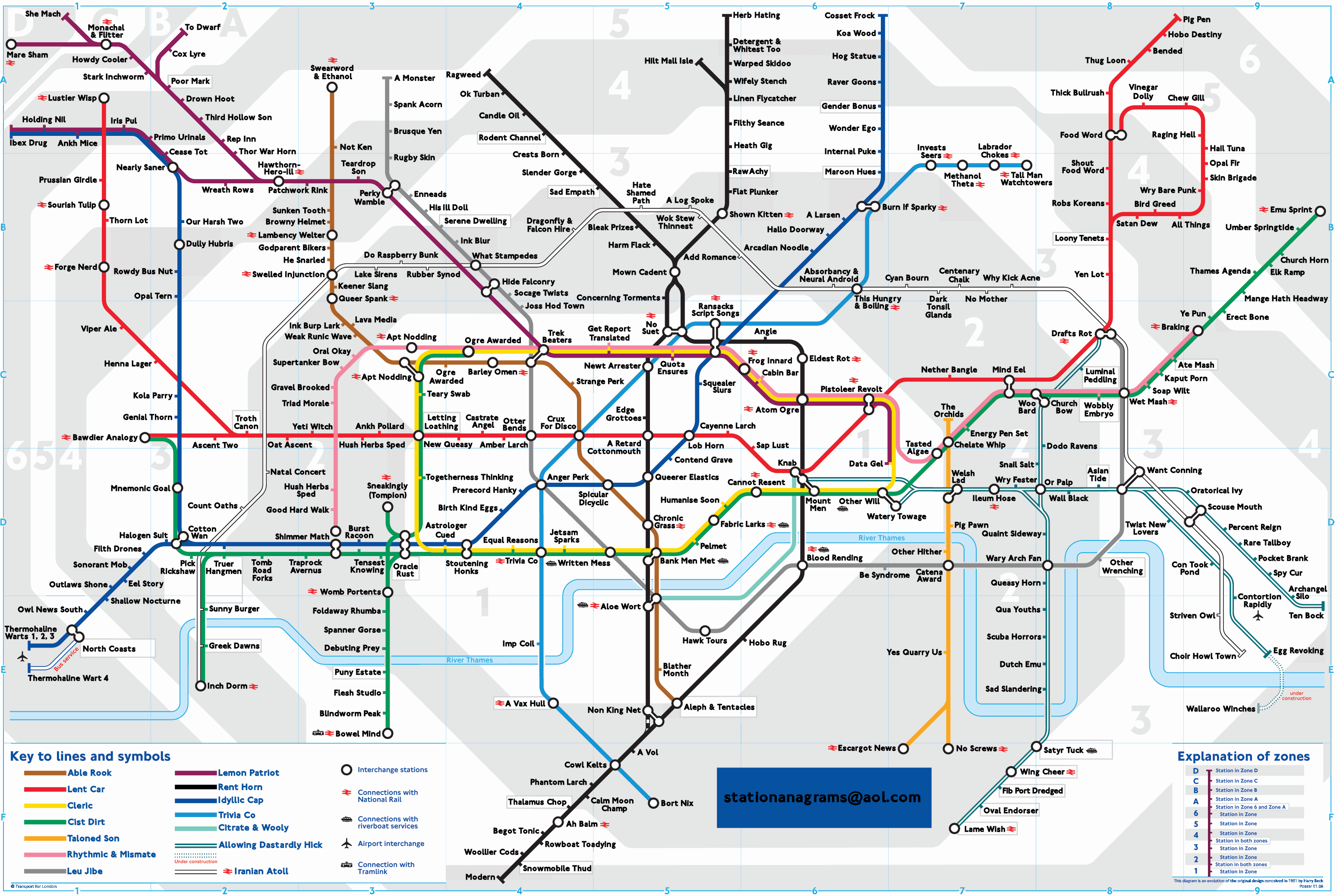
I love this map of the London Underground on which all the station and line names have been turned into anagrams (via Roger Darlington):


You’ll find the map very handy should you wish to do some shopping (or clubbing) around Crux For Disco, or catch a movie premiere at Queerer Elastics. A common attraction is the observatory at Wing Cheer, and you could also check whether Blood Rending really is falling down. If you fancy travelling a bit farther out, there’s the tennis at Bowel Mind or you can find out whether there really is a Raging Hell school! Sticking with fiction, why not see where Apt Nodding arrived from darkest Peru? Then there is, of course, the source of all British legislation, Written Mess. Finally, all you Humphrey Lyttelton fans will find this map essential when you’re trying to navigate to Concerning Torments.

(NB Fabric Larks is closed for rebuilding until late 2011. And there’s no interchange at Knab and Mount Men stations, except between the Allowing Dastardly Hick and the Rent Horn line.)

Saturday, September 05, 2009

Maths standards: 1976 vs 2008


These are only provisional results from a study, and I only have the media highlights to go on, but it’s dismaying all the same:

“The overwhelming conclusion is that there are far fewer changes in mathematical attainment over a 32-year period than might be expected, or which have been claimed," researchers said.
Academics from King’s and Durham gave 3,000 secondary school pupils a test in algebra, ratios and decimals last year. Pupils aged 11 to 14 were given the same independent exam as young people sat in 1976.
…
“There is no evidence for significant improvement, or significant deterioration, of standards between 1976/7 and 2008,” researchers said.
“Although performance in some areas has improved it looks as if, when all the results are analysed, there will be little evidence for the sort of step-change in mathematical attainment which might be suggested by the claimed improvements in examination results.”

That sentence I’ve highlighted is politically inconvenient for almost everybody involved in the perennial debate on standards – surely we all know that kids have either got commendably brighter or disgracefully dumber!

Friday, September 04, 2009

BMJ paper on waiting times

I can only access the abstract, but it sounds good:

Between 1997 and 2007 waiting times for patients having elective hip replacement, knee replacement, and cataract repair in England went down and the variation in waiting times for those procedures across socioeconomic groups was reduced. Many people feared that the government’s NHS reforms would lead to inequity, but inequity with respect to waiting times did not increase; if anything, it decreased. Although proving that the later stages of those reforms, which included patient choice, provider competition, and expanded capacity, was a catalyst for improvements in equity is impossible, the data show that these reforms, at a minimum, did not harm equity.

Perspective quiz

Complete the opening sentence to this article in today’s Independent:

  • The British Government's strategy in Afghanistan was thrown into crisis last night after…
  1. …the White House demanded that UK troops take the lead in Farah, Nimruz and Kandahar provinces as well as Helmand.
  2. …a major assault on the MoD Camp Bastion base revealed the Taliban to have far greater military capability than previously thought.
  3. …the Defence Secretary's right-hand man resigned in protest about the handling of the war.

I’m sure Eric Joyce has some fair points to make, but really.

Thursday, September 03, 2009

The effects of a party funding cap


The idea most commonly proposed around party funding reform is a donations cap. A £50,000 annual limit on donations from any individual or organisation was recommended by the Hayden Phillips review a while back. But there are plenty of disputed issues, not least whether trade union donations to Labour (or in theory any other party) should have the same limit applied or be treated as aggregates of many smaller individual donations, with the cap applying separately to these.

The Electoral Commission produced its latest set of donation figures last week, so I’ve taken a look at how either reform would have changed things. In the chart above, I show the actual donations (cash and non-cash) received by the three main parties over the year to June, as well as how the figures look if you cut out all donations from any given source above £50k, and how things would look if union donations were in effect exempt from this cap.

It’s no surprise that the Tories favour capping union donations: at present, they’re getting just under half the donations received by the three parties. With a blanket £50k cap, they’d go up to a massively dominant two-thirds. And it’s no surprise that Labour wants to keep its union funding.

My own view is that it’s reasonable for union party affiliation fees to be treated as aggregates of smaller donations as long as each individual member is explicitly giving a particular amount for this purpose, but for other contributions that are made by the union collectively to be treated as coming from a single donor. The result of this would put Labour’s funding somewhere between the second and third set of numbers in the chart.

If we assume that there will be no reforms before the election, that the Tories are very likely to win, and that they’ll take a self-interested view of funding reform, Labour and the unions will need to rethink their set-up if they are to retain significant financial links. What springs to mind is for union political activities to become much more devolved, with local/regional branches having their own political funds that they can allocate independently.

Wednesday, September 02, 2009

News: dominance and independence

This is a follow-up to my earlier post about James Murdoch’s anti-BBC speech, in light of Liam Murray’s critical response to me.

I’ll focus on two areas: dominance and independence.

Key to Murdoch’s argument was the charge that the BBC’s dominance crowds out the news market, particularly for new entrants.

My response was that News International does just that – and deliberately, rather than just as a side-effect of its presence. Like many large companies that have established themselves as market leaders, it finds itself less keen on a level playing field for its competitors. With a wide variety of large income streams, when it fears that one such stream may be under threat, it can divert money from elsewhere: most obviously by predatory pricing to undermine smaller competitors and set a high bar for potential newcomers.

This means that, for instance, the broadsheet (as was) market comes to function less as a market because the (Sun-subsidised) Times has more resources to draw on than it can generate for itself. It’s an anti-competitive practice that reduces the scope for others to offer greater choice. Liam suggests an analogy with supermarkets selling dirt-cheap bread as a loss leader, but that’s so that people will go there to buy bread along with the more profitable goods while they’re there. What more profitably priced NI products are Times readers buying along with their Times?

And it’s not pertinent that the source of the Times’s cross-subsidy is itself a commercial source; the point is that it comes from a different (tabloid) market and so creates distortions in this particular (broadsheet) market as surely as would a public-sector or charitable grant.

Now to independence.

Independence of what? Murdoch, as Liam says, lists a few things that one might be independent of, although he doesn’t elaborate on them (and one appears to be ‘dependency’ – hmm). I complained that two of these items – politics and subsidy – are actually not a form of independence you’ll find in News International. As to the others…

‘Absence of supervision’ – true, the BBC’s output gets a unique type of scrutiny from above. But then, in media companies, editors and commissioner still don’t get to do exactly what they like – they’re supervised by managers, directors, proprietors. ‘Independence of gift’ – what ‘gifts’ are BBC news staff being swayed by that private-sector reporters aren’t?

As for ‘independence of patronage’… good heavens. Every NI editor knows who their patron is, and his patronage pretty consistently promotes right-wing views, with limited exceptions when there’s a need to cosy up to a popular centre-left party. Of course his editors have discretion, but they’re picked with their views known in advance. The result is greater homogeneity than you might imagine.

And then there’s ‘independence of industrial faction’. Murdoch presumably equates this with producer interests such as unions and bureaucrats. It may not have occurred to him that owners of large corporations (both advertisers and the media themselves) are an industrial faction.

A large but simple question: why does independence matter for news media? It matters because dependence can breed systemic bias. Total impartiality is a chimera, although obviously some news outlets are more strongly and consistently biased than others. Different types of independence can guard against different types of bias, and independence of public funding (and of the types of accountability that come with it) is certainly one count on which the private-sector media have the edge over the BBC.

But on other counts the BBC is more independent: it’s independent of commercial pressures, of large corporate interests, of the prejudices of the type of people likely to own large media corporations. There are biases that it’s free from as a result. If a significant section of the media free from these sources of bias is something worth having – and I’m certain it is – then we shouldn’t look to the market to provide.

There’s an analogy with the House of Lords. One argument for hereditary peers is precisely that they’re there by accident of birth: they owe their seats to neither patronage nor party, so they’re independent in that sense. But what this overlooks is that the families that happen to have hereditary peerages are from a pretty narrow section of society (usually old money, mostly small-c conservative), with attitudes to match.

You can say a similar thing about a news market dominated by large corporations. I don’t want to go all class war on you, but the people who control these businesses have a limited range of views about economic and other policies – not just media laws. And even with the mild-to-middling anti-monopoly laws we have, there’s always a tendency toward oligopoly.

The BBC is a counterweight to news dominance by commercial interests, particularly by a few large private-sector players. It gives us, to put it non-idealistically, a broader range of biases to choose from, and this (popular) choice is not one that the market can adequately supply.

A final quick point on the licence fee in this context. Yes, in effect it’s a tax, and one could go from there into a general libertarian argument about the immorality of tax or a more specific one to the effect that most of the BBC’s output is hardly a ‘public service’. However, the thing is that Murdoch was specifically talking about news, not Strictly Come Dancing and all the other populist fluff. To his credit, he’s largely forgone the softer targets and headed straight for the worthiest public-service broadcasting jugular. His case would be much the same if the BBC only did news.

Tuesday, September 01, 2009

Have your pay

Anton Vowl has had a brilliant idea:

It's a simple way to monetise digital news while keeping content free to view for everyone. …
All newspapers have to do is simply charge for online comments. Call it "my two cents' worth" or something - and make it literally a couple of cents. People will be so incensed by the stories of the evil PC Brigade stopping ordinary middle-class Anglo-Saxon British families from writing racist abuse on bricks and throwing it through people's window - an appalling clampdown on free speech in this once-great country which has been ruined by ZaNuLab - that they'll be happy to pay a couple of pennies to have their say.

Very, very good. Harnessing the power of angry stupidity has a lot going for it. But I think there may be an even better idea – one that will also help to open up the ranks of journalism to new entrants.

Let online readers vote (for 50p a go, say) for which writer they want kicked off the paper each week.